Uninstallation of ADDS Role in Windows server 2016 Technical preview 4:

tp4-1024x512

Followed to my previous post on ADDS installation on Windows Server 2016 Technical Preview 4, I’ll be discussing on how to uninstall ADDS on this post. Ideally uninstalling the ADDS role means that you’re demoting your domain controller to be a normal server. Now, let’s take a look on the steps involved in demoting a domain controller.

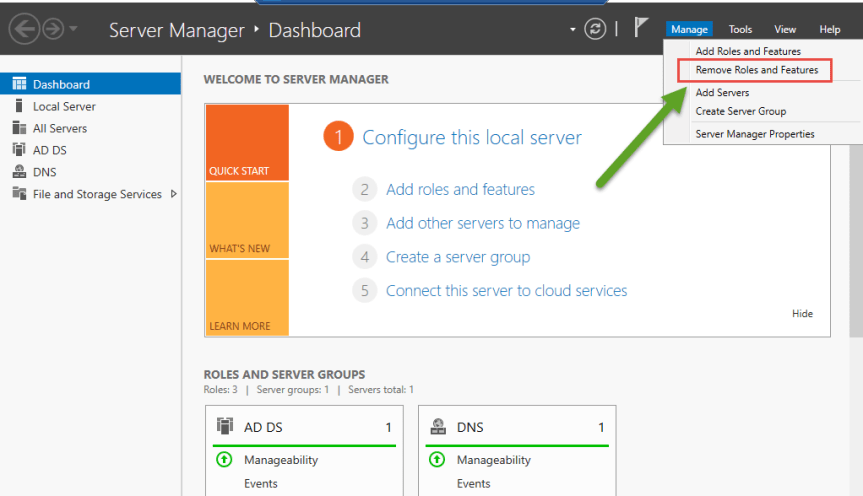
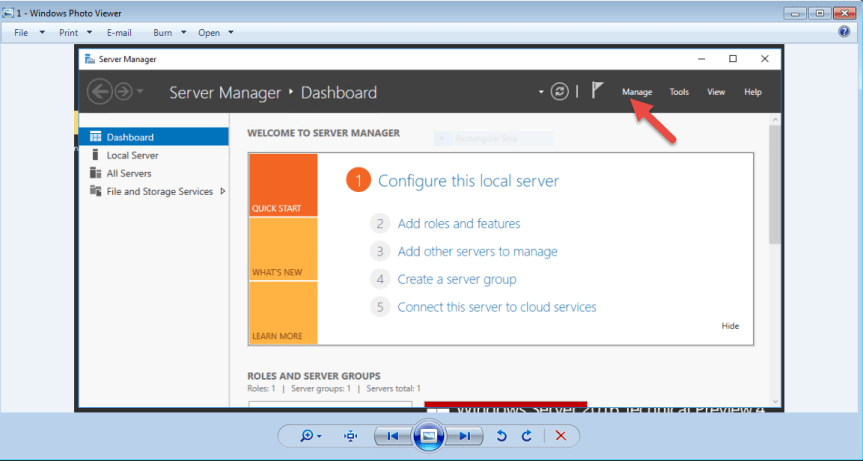
  1. Open server manager and click on the “Manage” button and choose “Remove Roles and Features “as shown in the image below.

1.PNG

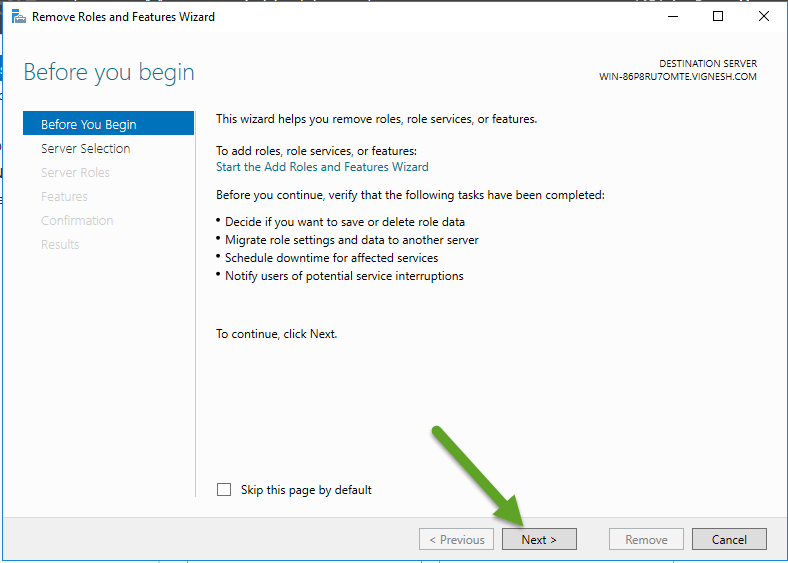
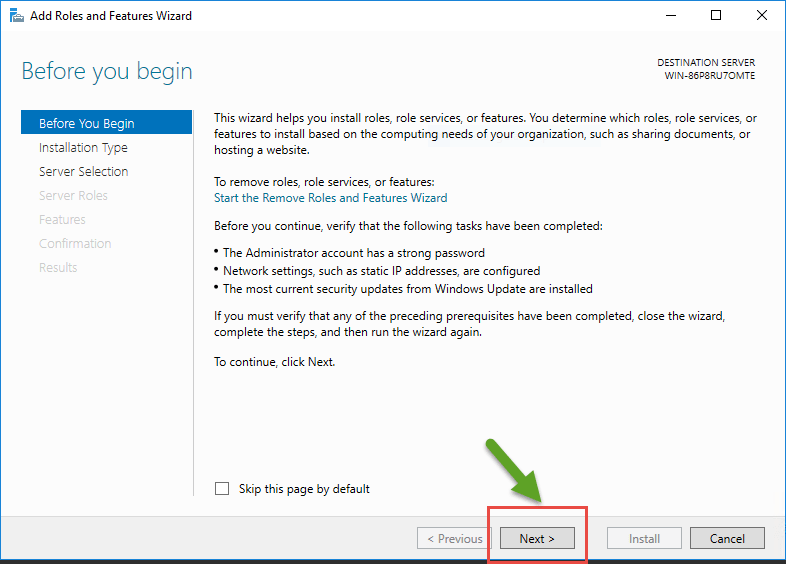
2. On the next screen, click “Next “.

2.PNG

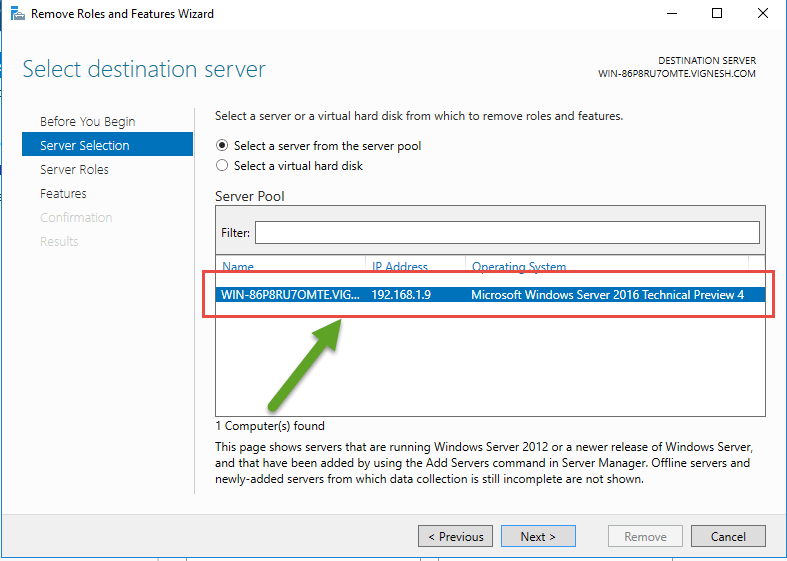
3. On select the destination server pane, select the server from which you want to remove the ADDS role as shown in the image below.

3.PNG

4. Choose the server and click next, in this scenario I have only one server in the server pool and this is the one that’s running the ADDS role. Click next and it will list you the list of roles.

5.PNG

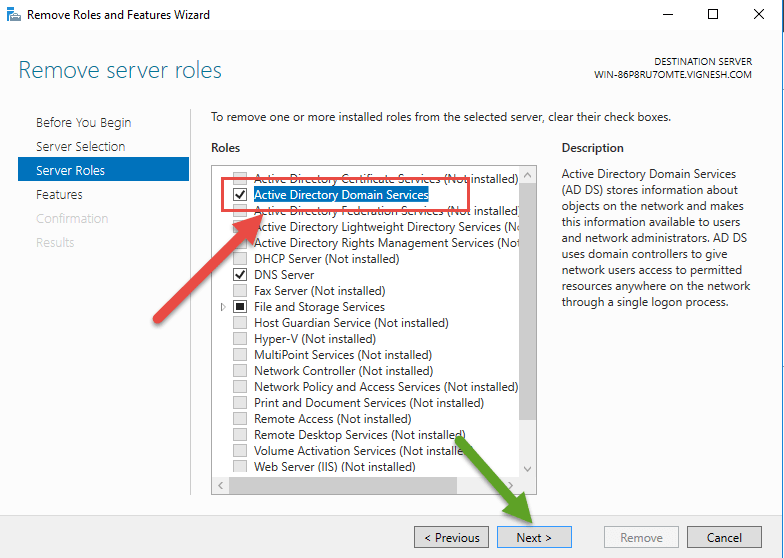
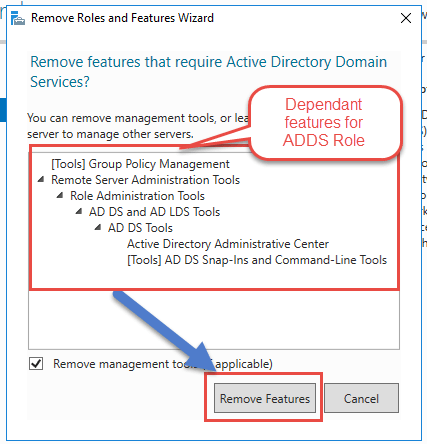
5. Choose “Active Directory Domain Services “role as shown above and click next. This will give you a window asking you to remove the dependent features for ADDS. Please go ahead and click on “Remove features “as shown in the image below.

6.PNG

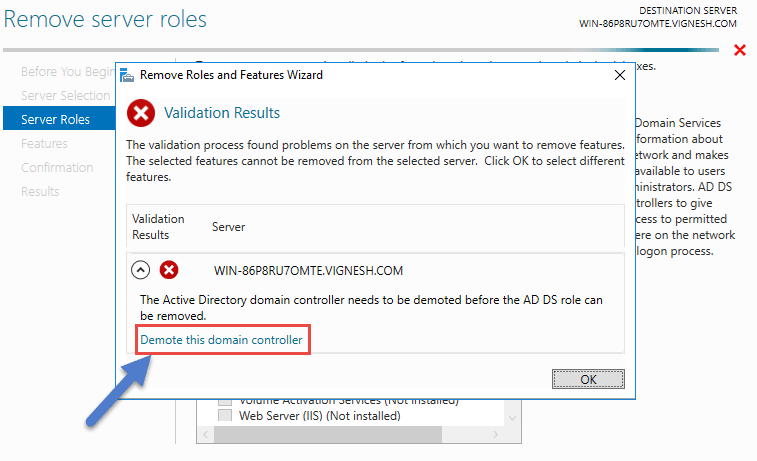
6. You will get a window as shown below. Please go ahead and click on “Demote this domain controller “

7.PNG

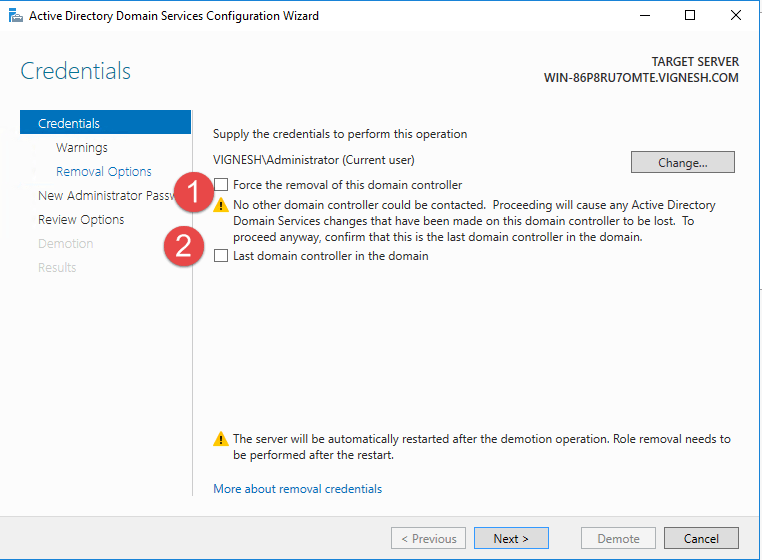
7. This will take you to a screen as shown below, please go ahead and click on next. You need to choose the appropriate option.

8.PNG

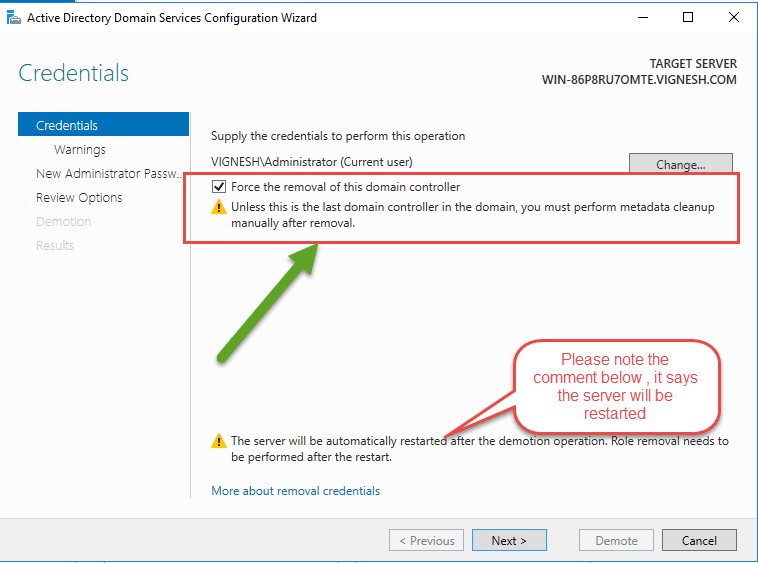
8. I’m choosing the first option which says, “Force the removal of this domain controller “and then click on next.

9.PNG

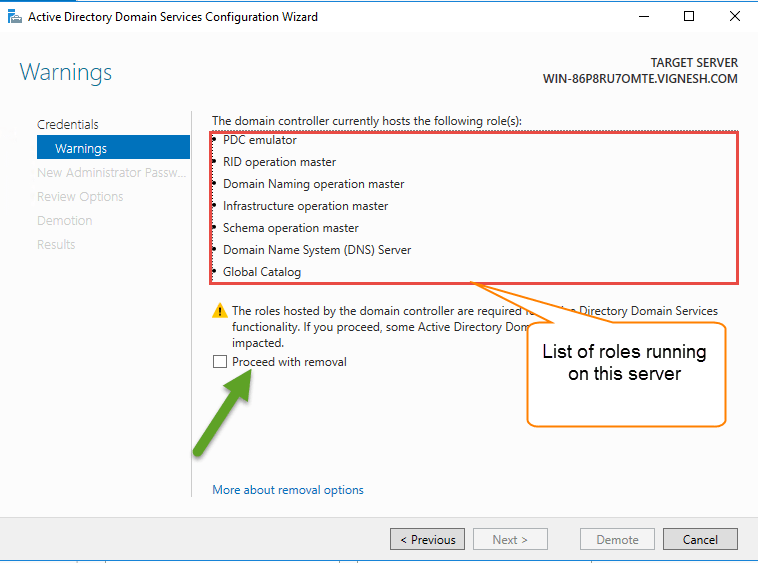
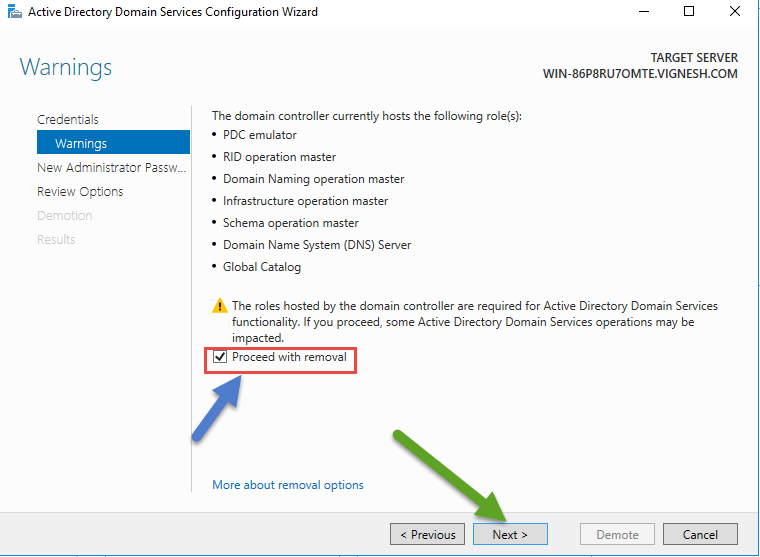
9. On the next screen please validate all the roles running on the domain controller and click on the checkbox which says, “Proceed with removal “and click next.

10.PNG

11.PNG

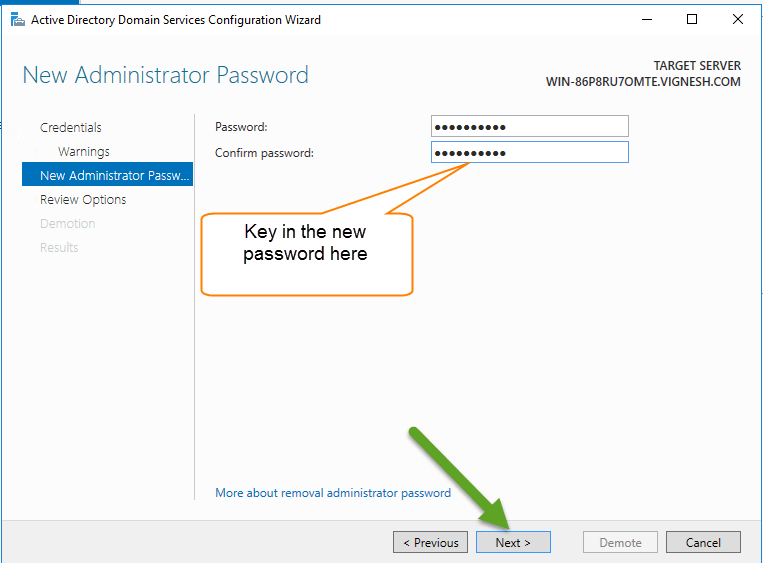
10. The next screen will be prompting for a new password .Please go ahead and specify the new password and click next.

Note: This password will be different from the normal domain administrator password.

12.PNG

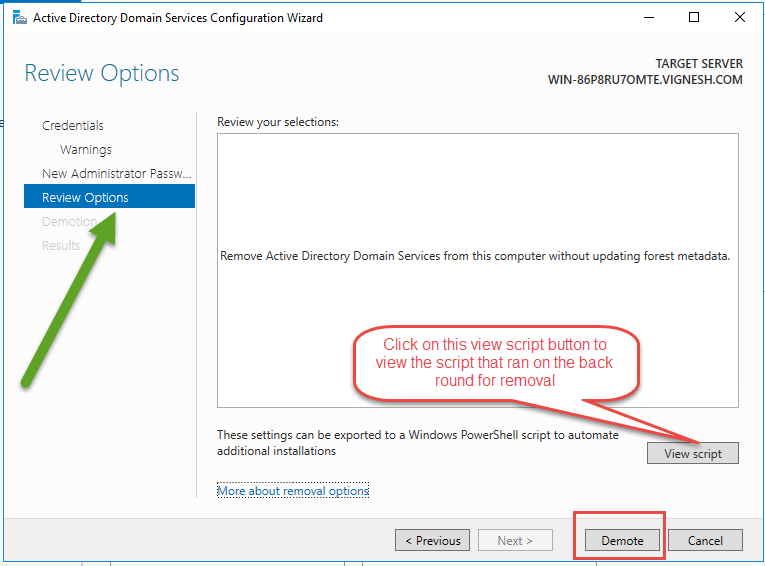
11. The next screen will ask you to review the changes made and once you’re done validating it please go ahead and click on the “demote” button to demote this server as shown in the image below.

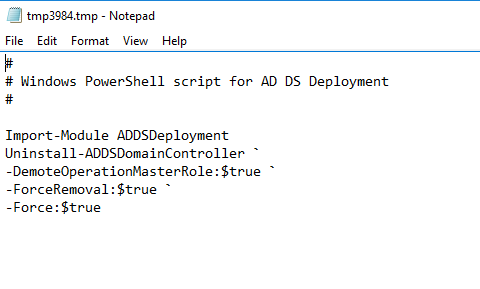
Note: Clicking on the view script button will generate the script that ran on the background when this activity was performed .You can use this script for future purpose also if you want to perform a ADDS uninstallation on any other domain controller .

13.PNG

14.PNG

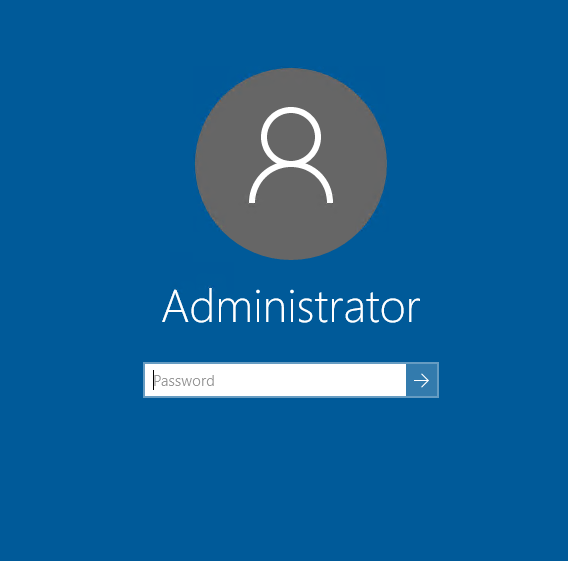
12. Finally once this is done your server will be restarted and then you will notice that this server is no longer a domain controller. You can confirm this on the logon screen itself where you would just see the logon username and not the domain name prefixed to it. In my case below I’m logging in as the administrator and you won’t see the domain name prefixed before.

15.PNG

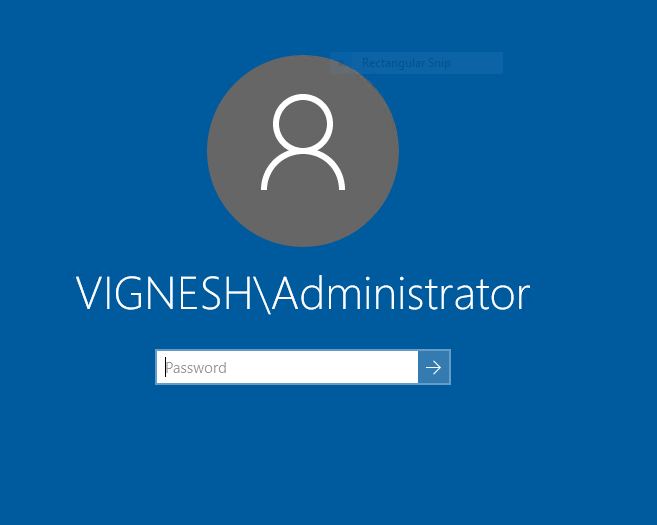
13. Before uninstalling the ADDS role, this is how the logon screen looked. Check the logon screen below. You can see my domain name “VIGNESH” prefixed before the logon name.

16.png

Demystifying SharePoint server licensing:


1.png

So this post is to explain how SharePoint server licensing works. To be honest I often used to stumble around trying to understand how this entire thing works and after doing a lot of research in the internet I was able to understand how the entire licensing part works and hence I wanted to write an article on that hoping that it would help you all to have a better understanding about SharePoint Server licensing.

With that being said, I’ll be discussing about SharePoint server licensing in 2013 and Office 365 and how things are expected to change in SharePoint server 2016 as well. So before we get started let me go ahead and define certain terminologies that I’ll be using often in this post so that you can have a better understanding about those terms when I’m using that in this post later.

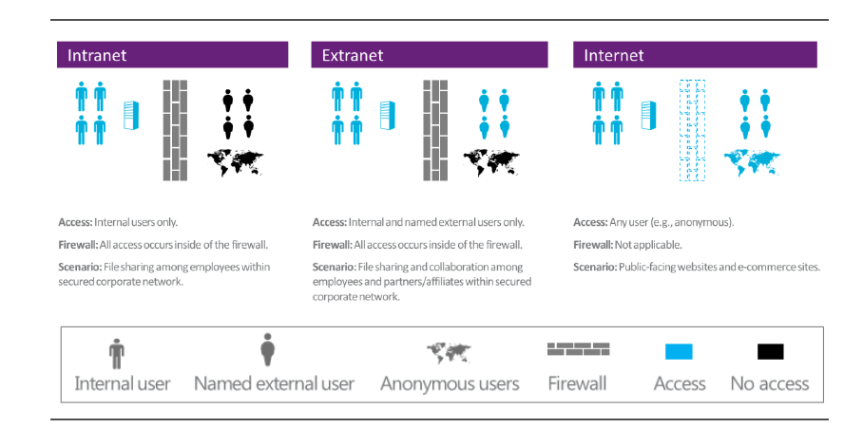
Internal Users: Users who are the licensee’s or its affiliates’ employees and on-site agents and contractors (i.e. Users who are present in your domain and have an account in AD)

External Users: Users who are not the licensee’s or its affiliates’ employees or on-site agents or contractors (i.e. Users who are not present in your domain and don’t have an account in AD).

Intranet: Website hosting content, information, or software that is accessible inside the firewall to internal users only (i.e. Within the company’s firewall).

Extranet: Website hosting content, information, or software that is accessible inside the firewall to internal users and named external users only.

Internet: Website hosting content, information, or software that is publicly accessible to all users (internal and external). (i.e. Outside the company’s firewall)

CAL:   Client Access License.
2.png

Microsoft licenses SharePoint server 2013 using the Server/Client Access License licensing model.  The Server/CAL licensing model requires both the server license on which it’s (i.e. SharePoint application) installed as well as the CALs for the users (or devices) that access the application. To be more clear you need license for each server on which SharePoint is installed and apart from that you also need licenses for the users (or devices) that access SharePoint. However, please note that the CAL requirements may vary based on user status and CALs are generally required for internal users to access all SharePoint server software. The only exception to this is, internal user access to Internet websites (public-facing websites such as e-commerce SharePoint sites) .In these cases, the SharePoint CAL requirement is waived. On the other hand, this is not the case for external users, you don’t need to purchase any extra license for external users and the server license by itself will take care of their access. Please note that there can be couple of ways to leverage access to external users to access SharePoint such as (Anonymous authentication, Forms-based authentication etc. …However, an external user who still has a user account in your AD won’t be considered as external as per SharePoint sever licensing model if he’s using his AD account to access SharePoint). So it’s very important to choose external users access carefully or else you might end up paying licenses for them as well.

I would also like to touch base on the “devices” part which I mentioned earlier so that you have an understanding about how that would have an impact on SharePoint licenses. Let’s consider a scenario where you’re accessing your SharePoint site from your workstation and at the same time you’re logged into the SharePoint site from your smartphone as well, then that’s two devices accessing the same site. SharePoint doesn’t consider that as a single license, its takes it as two different devices accessing the same site. This is where the device licenses come into picture. So it’s very important that you choose the correct licensing model.

User CALs:

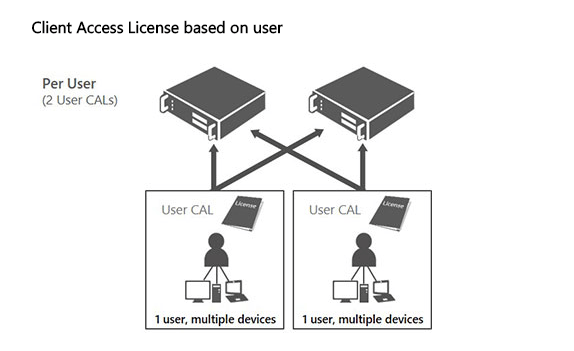
With the User CAL, you purchase a CAL for every user who accesses the server to use services such as file storage or printing, regardless of the number of devices they use for that access. Purchasing a User CAL might make more sense if your company’s employees need to have roaming access to the corporate network by using multiple devices, or from unknown devices, or if you simply have more devices than users in your organization.
3.png

Device CALs:

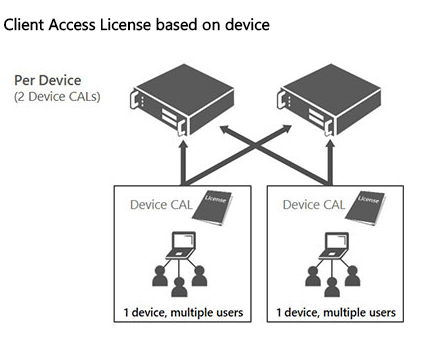
With a Device CAL, you purchase a CAL for every device that accesses your server, regardless of the number of users who use that device to access the server. Device CALs may make more economic and administrative sense if your company has workers who share devices, for example, on different work shifts.
4.png

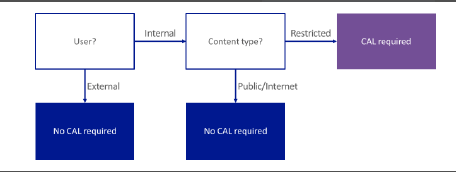
The following diagram depicted below illustrates whether a user needs a SharePoint CAL or not. “Restricted” refers to content stored inside the firewall for internal access and possibly limited, identified external user access. “Public/Internet” refers to content stored outside the firewall for broad, unrestricted access.
5.png

Now, let’s take a look at certain scenarios which can give us a better explanation on how the licensing part works for internal and external users.

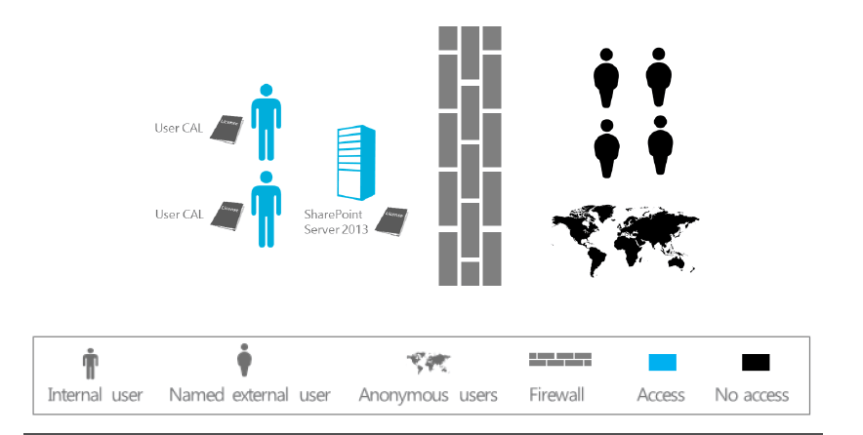
Scenario A: Intranet

Description: Internal users accessing content, information, or applications inside the firewall through a local area network (LAN) or the Internet. No other users have access.

Example: A professional sports team sets up an intranet site that the manager, coach, and players access. It is also used for support staff such as the physiotherapist who is an on-site contractor rather than an employee, and for CAL requirements, an internal user. A news reporter trying to access the SharePoint Server site is denied access.

Licensing:

Server: One SharePoint Server 2013 license per running instance of the software.

Internal Users:  One CAL/user.
6.png

As shown in the above image, the internal users (the team’s managers, coach, players, and on-site therapist) each must be assigned a CAL. This requirement does not change if the same users are accessing the intranet site remotely from the team’s offices. Given that this is an intranet site, no external user access is permitted.

Scenario B: Extranet

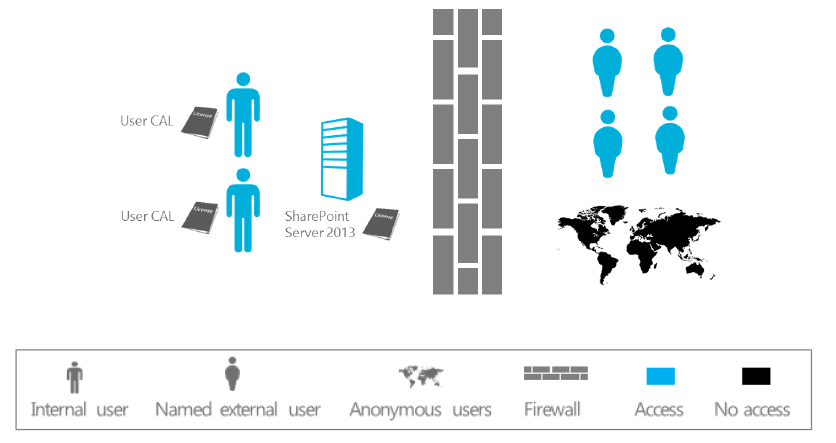
Description: An organization extends access to otherwise restricted content inside the firewall to a limited number of identifiable external users.

Example: The Elm University publishes research papers that are available to specific educators from other universities (external users). This situation is an intranet plus extranet scenario.

Licensing:

Server: One SharePoint Server 2013 license per running instance of the software.

Internal Users: One CAL/user.

External Users: SharePoint CALS are not required; the server license permits external user access.
7.png

As shown in the above image, the internal users (the school’s faculty and staff) each must be assigned a SharePoint CAL. This requirement does not change if the same users access the site remotely while they are off-campus. The identifiable external users (educators from other universities) who are permitted to access otherwise restricted content inside the firewall do not require SharePoint CALs, because external user access is permitted under the server license. No other users are permitted to access the site.

Scenario C: Internet

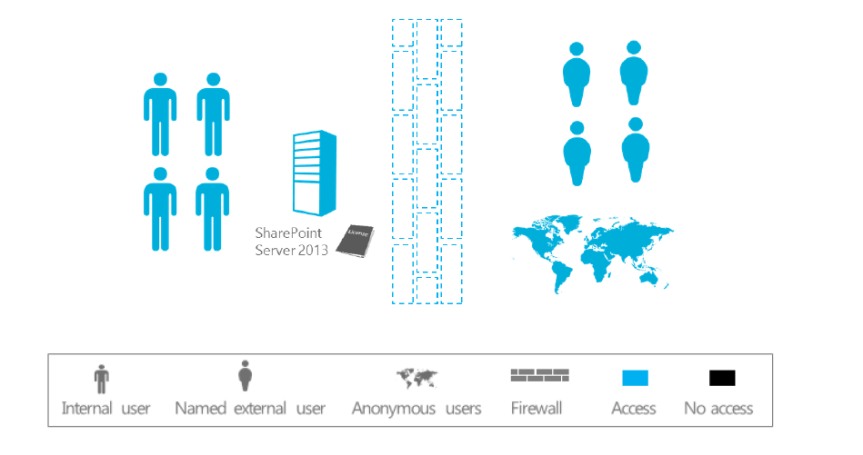
Description: Internal users make content, information, and applications publicly available to users via the Internet (for example, on a public-facing company website). A mix of internal and external users anonymously accesses the site, including employees. No SharePoint CALs are required. External user access is permitted under the server license, and SharePoint CAL requirements for internal users are waived for access to content, information, and applications made publicly available via the Internet.

Licensing:

Server: One SharePoint Server 2013 license per running instance of the software.

Internal Users: CALs are not required.

External Users: CALs are not required.
8.png

As shown in the above image, access is unrestricted. The only license required is the server license. SharePoint CALs are not required to access content, information, and applications made publicly available to users via the Internet (that is, not restricted to intranet or extranet scenarios). The same licensing applies for an e-commerce site where access is not strictly anonymous. Again, SharePoint CALs are not required to access content, information, and applications made publicly available to users via the Internet.

Licensing has been simplified in SharePoint 2013. SharePoint Server 2013 collapses internal and external use under a single licensing offering/model.

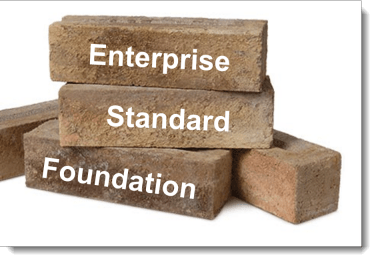
In addition to the points that we discussed above, there are certain classifications in the CAL that we need to be aware of as this will be very helpful in choosing the right version of SharePoint with the right features for your company. The CAL can be classified into two types 1.  Standard CAL and 2. Enterprise CAL. Check the table below to know the difference between Standard and Enterprise CAL.

Standard CAL You get features such as sites, communities, content and search in Standard CAL.


Enterprise CAL You get features such as such as Access Services, InfoPath Services, Power View, PerformancePoint Services, Excel Services, Reporting services and Visio Services.


SharePoint Standard CAL:

The Standard CAL delivers the core capabilities of SharePoint

Sites: a single infrastructure for all your business websites

Communities: an integrated collaboration platform

Content: enterprise content management (ECM) for the masses

Search: people and expertise search, visual previews, visual best bets


SharePoint Enterprise CAL:

The Enterprise CAL delivers the full capabilities of SharePoint

Sites: a single infrastructure for all your business websites

Communities: an integrated collaboration platform

Content: ECM for the masses

Search: standard search features plus entity extraction, video search, item recommendations

Business solutions (includes Access Services and InfoPath Services)

Business Intelligence for everyone (includes Power View, PerformancePoint Services, Excel Services, and Visio Services)

Check this link to have a detailed overview of all the features available in both the versions (i.e. Enterprise and Standard): _ http://www.fpweb.net/sharepoint-2013/compare-sharepoint-server-standard-enterprise/

Alright, I guess we have talked enough about SharePoint Server 2013 licensing, now let’s a look on how things are expected to change in SharePoint 2016.

SharePoint Server 2016 licensing:
9.png

For the most part the licensing is expected to remain the same in SharePoint server 2016 as well. You have the same server CAL license and user (or devices) licenses in SharePoint Server 2016 as well and this hasn’t changed. However, as you all are aware, SharePoint 2016 has a major change in terms of its architecture .We have a new concept called as “MinRoles” that was introduced in SharePoint Server 2016 .MinRole enables SharePoint Administrators to limit a SharePoint server to a specific role (i.e. front end, application server, distributed cache and custom). So using MinRole you can make a SharePoint server only do the specific role which it’s expected to do based on the role it has been assigned to .This will definitely lead to a downside in terms of licensing as using MinRole the server will only do a specified task .Let me explain this with an example ( If you have your current SharePoint 2013  application server in your production farm running search , user profile and MMS etc. ….you won’t be able to run all these services in a single app server once you migrate to SharePoint server 2016 .You have to assign a specific server only for SharePoint search ) .So obviously this will lead to  purchasing extra licenses if you need to utilize more services .

sql2016.jpg     windows_server_2016_gradient.jpg

Also in terms of the necessary software prerequisites, SharePoint Server 2016 requires Window server 21012 R2 or Windows Server 2016 as the underlying operating system and also coming to the backend SQL server you need 64-bit edition of SQL Server 2014 SP1 or SQL Server 2016. Another important point to note is, SharePoint 2016 doesn’t have any foundation version. You get only standard and enterprise version. Please note that there are few changes that has implemented in SQL Server 2016, you have a new component called PolyBase that has been introduced in SQL Server 2016. This mainly takes care of combining both relational data and non-relational data within SQL Server itself. You can also run queries on external data in Hadoop or Azure blob storage using this. The key factor to note here is that, “PolyBase “can run only on a single instance in a SQL Server. If you have multiple instances of SQL running on the same server then you may not able to run “PolyBase” on all the instances. So please the “PolyBase” configuration accordingly.

SharePoint Online and Hybrid:
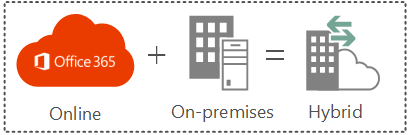
HYBRID.gif

Let’s see how licensing works on SharePoint Online and Hybrid, it’s a known fact that SharePoint Online has become a buzzword over a period of time and we can see a lot of organizations moving their on-premises SharePoint workload to cloud. However, I’ve noticed a lot of SharePoint professionals as well as project managers having a confusion on how licensing works for SharePoint Online and what has to be done for a successful SharePoint Hybrid implementation.

So just to clear the confusions about this, SharePoint on-prem as already discussed is server/CAL license based whereas SharePoint Online is subscription based. As you all know, most of the cloud services today are subscription based and their licensing is totally different from on-prem platforms. Azure and Office 365 are good examples for cloud based platforms that works based on subscriptions. However, there is a minor difference in terms of subscription between these two products (i.e. Office 365 & Azure) and I’ll be discussing about that in a different post.

With Office 365 (SharePoint Online) you get two types of plans, i.e. Plan 1 and Plan 2. Please check this link below to have a proper understanding of the features involved in both these plans.

https://products.office.com/en-us/SharePoint/compare-sharepoint-plans?legRedir=true&CorrelationId=d1645733-7515-401f-904a-f75983522c29

It’s up to you and your business to choose the appropriate plan that best suits your business need.


Now, before discussing SharePoint hybrid licensing, let’s take a look at the traditional on-premises scenario. Historically, SharePoint on-premises customers were required to purchase a server license for each SharePoint server, with a client access license (CAL) required for each user or device that will be accessing those servers. There was also an optional Enterprise CAL, sold on a per-user base for accessing additional features (Ex: SSRS).

When cloud services are added to the mix, this relatively straightforward scenario becomes more complicated. As a subscription-based service, SharePoint Online is bought through a monthly per-user fee, instead of licensing.

Roughly around 2 years ago, Microsoft attempted to simplify licensing for hybrid SharePoint deployments by allowing Office 365 user licenses to be used as CALs for accessing SharePoint resources that reside on-premises. In other words, organizations that had both local and cloud-based SharePoint resources would have to purchase server licenses for each on-premises SharePoint server, but would not be responsible for purchasing CALs, as long as every user accessing the on-premises SharePoint resources had SharePoint Online as part of their Office 365 subscription.

But things have changed a bit now, if an organization runs SharePoint in its data center and decides to extend its deployment to the Office 365 cloud, verifying that the local environment is properly licensed is the first thing to do. As previously mentioned, each SharePoint server requires a server license. Unlike CALs, there is no “enterprise” upsell for the servers. Organizations must simply purchase a SharePoint server license, and any required dependency licenses, such as for Windows Server and SQL Server.

The organization will also have to purchase CALs for each person or device that will access SharePoint. Microsoft offers Standard CALs and Enterprise CALs. The Standard CAL provides access to SharePoint’s core capabilities, such as sites, communities, content management and search.

Organizations that need SharePoint capabilities beyond those covered by the Standard CAL should purchase an Enterprise CAL — in addition to the Standard CAL — for each user or device that will access those resources. The Enterprise CAL provides access to features such as Power View or Excel Services.

With the Hybrid scenarios in place now, choosing the correct license/subscription might be bit confusing. To make this simple, please take a closer look at SharePoint Online Plan 1 and Plan 2 once again. Plan 1 for SharePoint Online is more or less matched to the features that are delivered through a Standard CAL, while SharePoint Online Plan 2 is closely matched to the SharePoint Enterprise CAL. There are some minor differences between the Standard CAL and SharePoint Online Plan 1, just as there are some minor differences between SharePoint Online Plan 2 and the Enterprise CAL, but mostly these hosting plans are closely matched to their on-premises counterparts.

To be more precise, let’s consider a scenario where you want to implement Hybrid search in your environment and you’re confused to choose the appropriate plan. In such case, take a look at the type of search that has been implemented in your on-premises SharePoint Farm. Is it normal search or Enterprise search? For the most part I bet it would be Enterprise search, then in such case you need to assign Plan 2 license in SharePoint Online for all the end users as only then they would be able to see the search results from SharePoint on-premises or vice versa. To know more about Hybrid search, please click this link to take a look on my blog post about Hybrid search.

SimplifiedSharePointhybriddiagram_th[4].png

Last but not least, let’s take a look at licensing for SharePoint foundation. With SharePoint foundation, you don’t need to purchase any SharePoint license for SharePoint Foundation as it’s a free version. The only license you would need is the Windows server license on which SharePoint Foundation would be installed. You would also not require separate license for SQL Server as SharePoint foundation installs SQL Server express by itself while running the set up file.

Note: As already mentioned above, SharePoint 2016 doesn’t have any foundation version. You either get the Standard version or the Enterprise version.

Finally, to conclude, as SharePoint professionals it’s very important that you have a proper understanding of how licensing works in SharePoint on-premises and SharePoint Online as choosing the correct version/license is vital for any successful SharePoint implementation. If your organization uses SharePoint just to dump the documents and the usage is also very minimal where no enterprise features would be used, then choose the standard version. On the other hand, if you’re organization uses SharePoint for collaborating with customers /other stakeholders and also the dependency of enterprise features is more then choose the enterprise version. As far SharePoint Online/Hybrid is concerned choose the appropriate plan for the end users that best suits the business need. When it comes to migration where you would be migrating from on-premises version to the other one (preferably from 2013 to 2016) please make sure that considering the licenses for other supporting software’s also (i.e. SQL Server & Windows server).

Thanks for reading this post. Happy SharePointing!!!!


Active Directory Domain Services Installation on Windows Server 2016 Technical Preview 4:

Alright, to all the system administrators out there, this post would be on how to promote your Windows server 2016 to become a domain controller by installing the “Active Directory domain services” role on it. The installation is no different from what we have been doing on the previous versions of Windows server and almost all the steps are the same.

With that being said, let’s get started with the installation steps now,

  1. Open server manager as shown in the screenshot below and click on “Manage”

1.PNG

2. Once you click on “Manage” you will see an option which says ” Add roles and features “ , choose that and click  next .You can also click on ” Add roles and features” which you see on the server manager pane above to add the necessary roles and features.

2.PNG

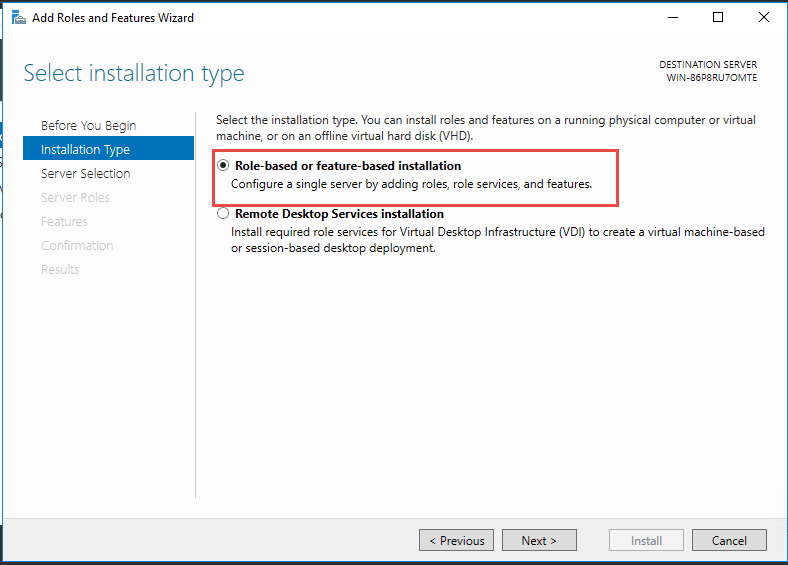
3. Choose “Role based or feature-based installation “option and click “Next “as shown in the screen below.

3

Note:

  • Role-based or feature-based installation: This installation type installs or removes the various roles and features included with Windows 8 Server operating system editions.
  • Remote Desktop Services scenario-based installation: This new installation type enables the installation and configuration of Remote Desktop Services.

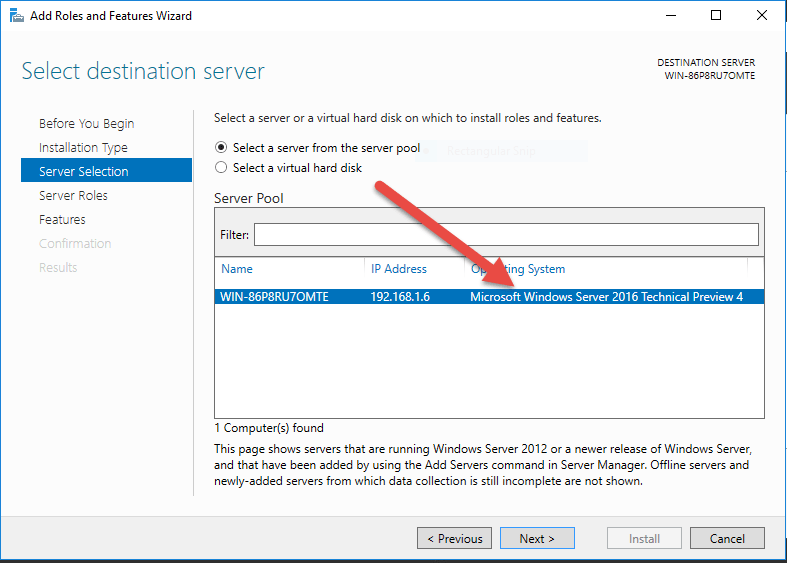
4. On the next screen which says “Select destination server “, choose the appropriate server on which you need to install the ADDS role. In this scenario you can see the server being highlighted below on which I would be installing the ADDS role.

Note:

  • Select a server from the server pool: Use this option to select a server from the server pool on the local computer. Confirm the destination by verifying the destination server in the upper right hand corner of the wizard.
  • Select a virtual hard disk: Use this option to select a local or remote Windows 8 Server virtual hard disk file. Only virtual hard disks that contain a Windows 8 Server operating system are valid destinations. Blank virtual hard disks or hard disks that contain an operating system other than Windows 8 Server will fail.

4.PNG

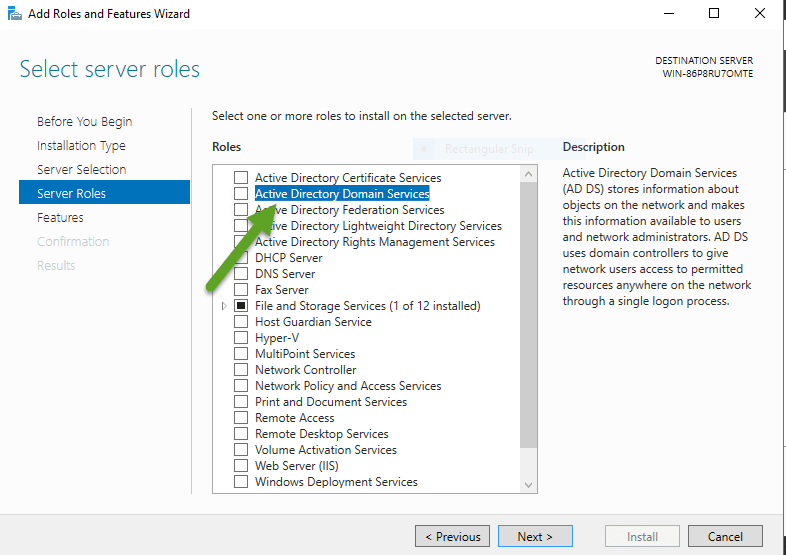
5. Now since we have selected the destination server, it’s time to go ahead and install the ADDS role on it, for that please check the screenshot below. On the sever roles pane, please check the checkbox for “ Active Directory Domain Services” and click “Next” as shown in the screenshot below .
5

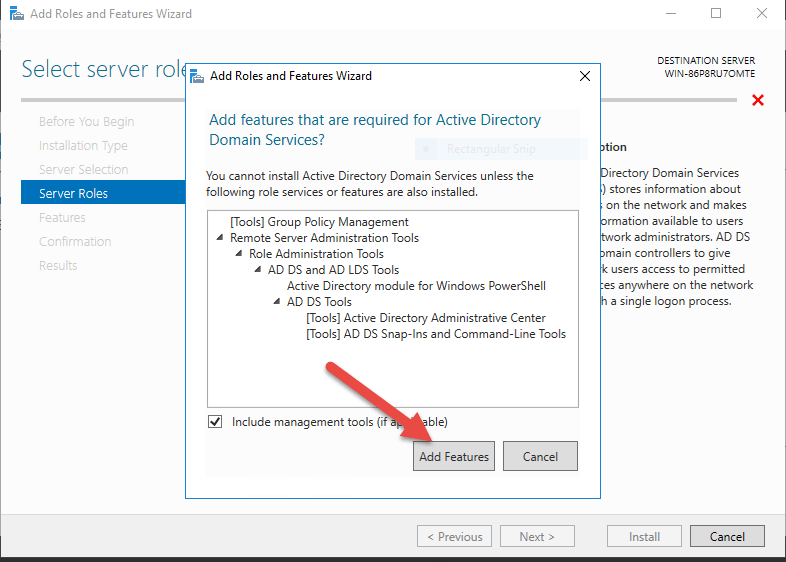
6. Once done you will get a window which asks you to add the necessary features for “Active Directory Domain services” role , please go ahead and click on “ Add features” button so that it will add all the necessary features for ADDS.

6

Note:  The checkbox which says “Include management tools (if applicable) “option has to be chosen only when you need to include management tools as a part of adding the features.

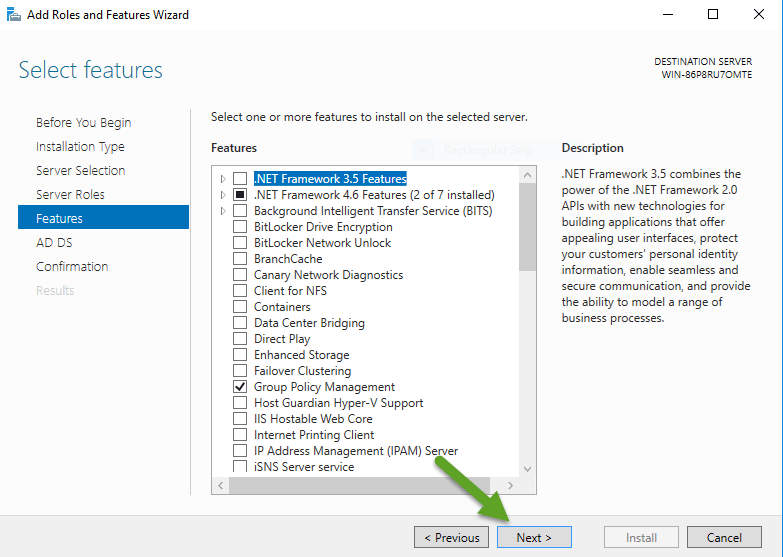
7. Once you’re done with adding the necessary features the next screen would ask you to add some other features if required, please go ahead and click “Next” as we have already added the necessary features in the previous screen.

7.PNG

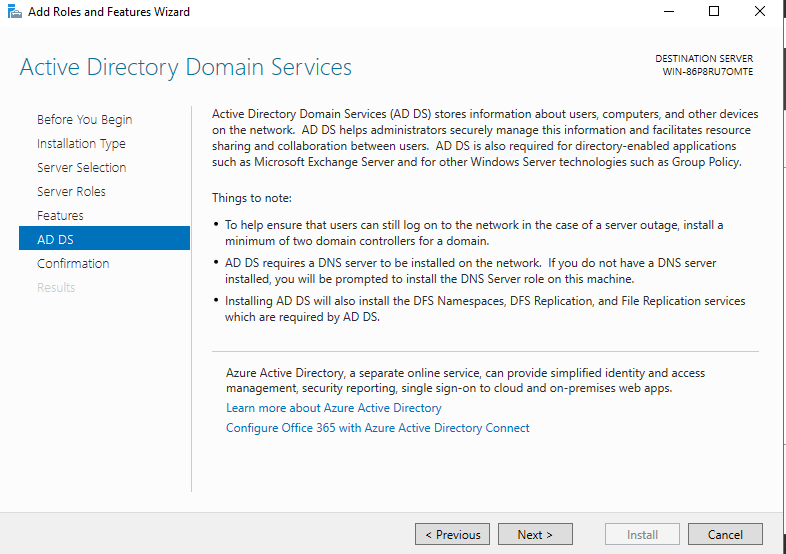
8. The next screen would give you an explanation on what ADDS is all about, please review it if interested and click “Next”.

8.PNG

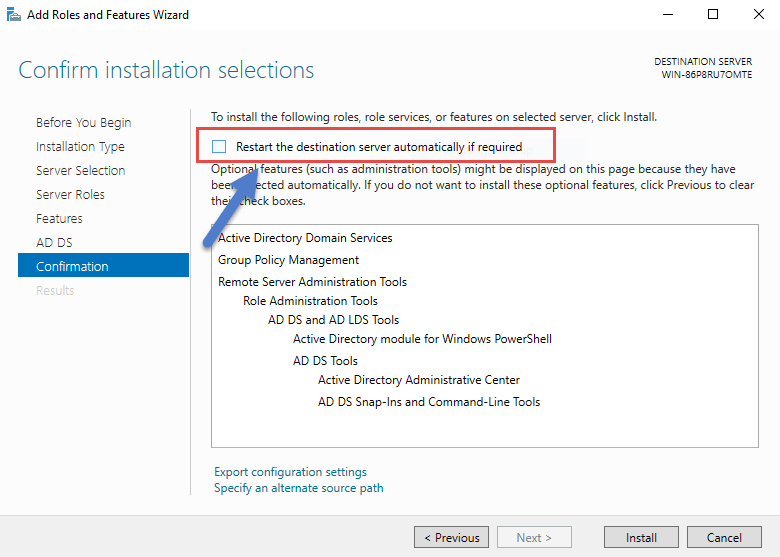
9. On the next screen, check the checkbox which says “Restart the destination server automatically if required “and click on “Install”.

9.PNG

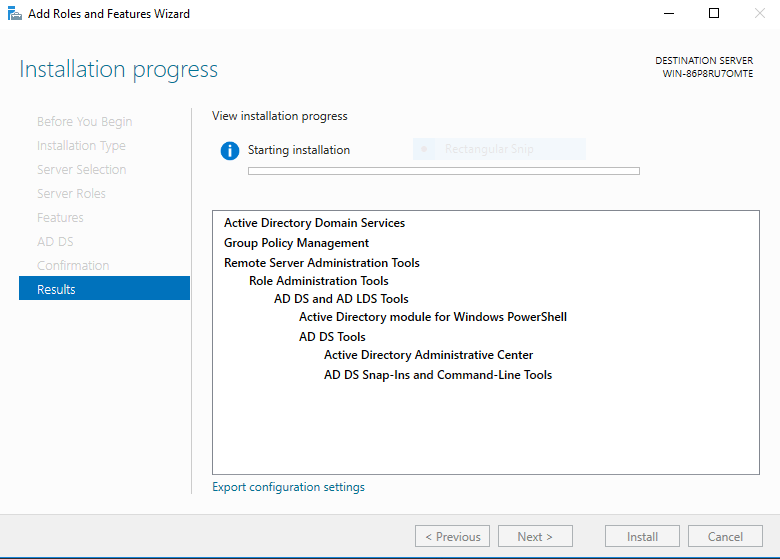
10. You can notice the Installation getting started on the next screen.

10.PNG

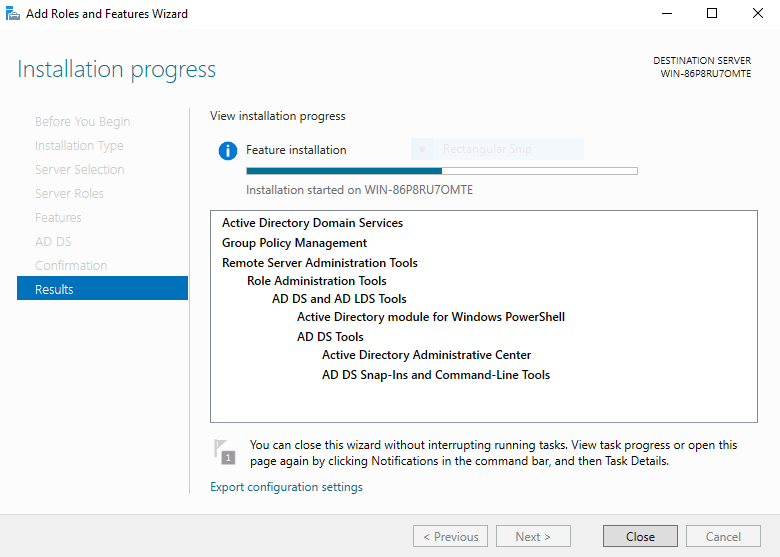
11. You can also notice the Installation progressing eventually as shown in the screen below.

11.PNG

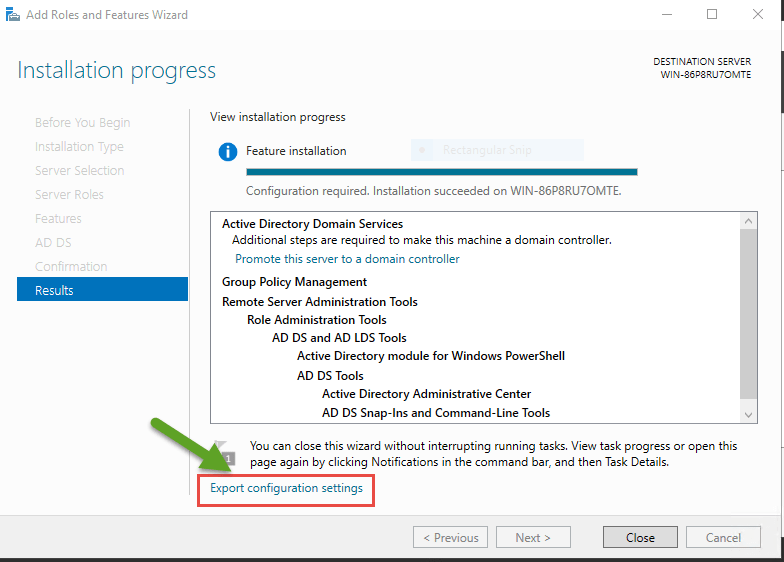
12. Finally you will get the screen which says the installation is succeeded as shown in the screenshot below.

12.PNG

Note : You can click on “Export Configuration settings” option to export the settings to a notepad .The same configuration settings can be used for feature installations also .

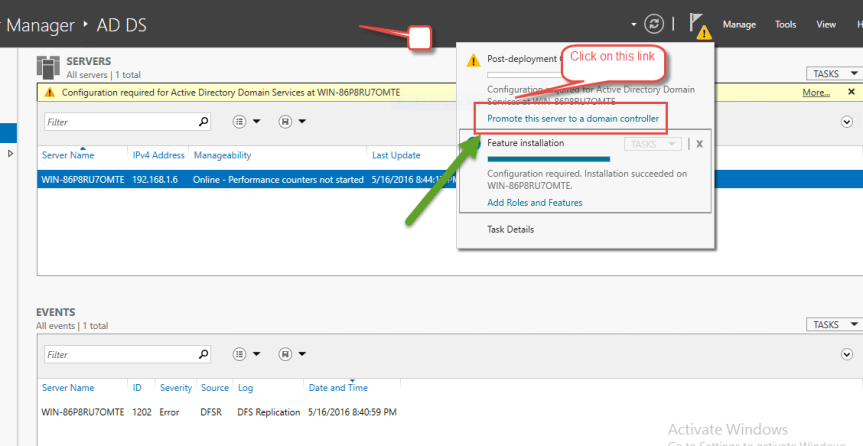
13. Once this is done, please click on close and then open server manager .You will see an option which says “Promote this server to a domain controller “on the top right corner of the screen. Please click on that.

15.PNG

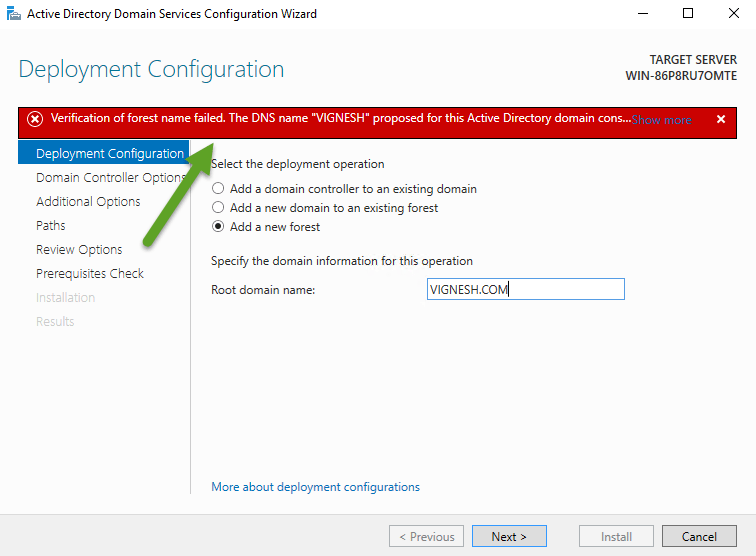
14. Now on the next screen where it asks you specify the “root domain name” , please go ahead and entire your domain name .

17.PNG

Things to note while entering the domain name: Make sure you’re entering the domain name which you own, if it’s a lab environment and you’re connected to the internet you need to specify unique domain names which is not being used by others. You can’t enter a domain name which is owned by someone or by any company. So please make sure you abide to these things while entering the domain name.

The error which you see in the above screen is because I didn’t enter the root domain name correctly .The root domain name should be entered in this format (i.e. “domain name”.COM) and by any chance if you don’t do that correctly you will end up noticing that error message.

15. So please ensure that you’re entering the domain name correctly in the correct format and click on next, this will take you to the next screen which asks you to specify the domain controller options.

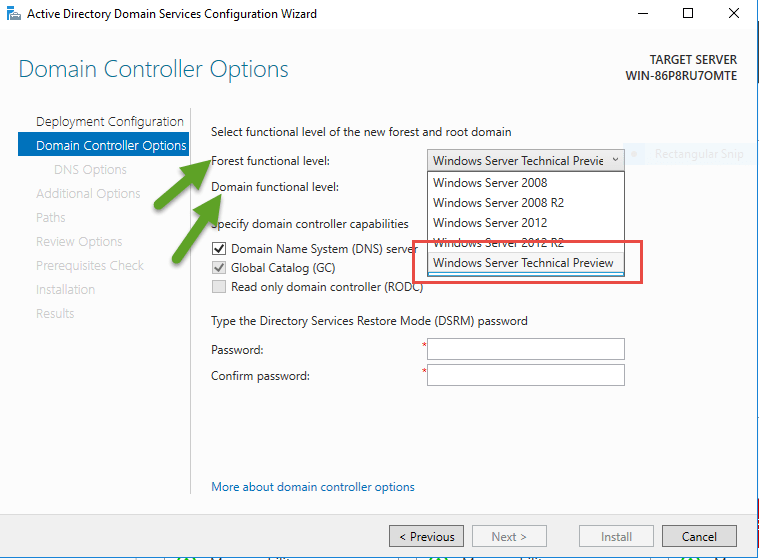
18

Now, on the above screen you will see an option which says “forest functional level” and “domain functional level”.  Now it’s very important that you choose these options very carefully or else you will end up in a scenario where you may not be able to add additional domain controllers to the server.

So let me try explaining what is a forest functional level and domain functional level, Functional levels determine the available Active Directory Domain Services (AD DS) domain or forest capabilities. They also determine which Windows Server operating systems you can run on domain controllers in the domain or forest. However, functional levels do not affect which operating systems you can run on workstations and member servers that are joined to the domain or forest.

When you deploy AD DS, set the domain and forest functional levels to the highest value that your environment can support. This way, you can use as many AD DS features as possible. For example, if you are sure that you will never add domain controllers that run Windows Server 2003 to the domain or forest, select the Windows Server 2008 functional level during the deployment process. However, if you might retain or add domain controllers that run Windows Server 2003, select the Windows Server 2003 functional level.

When you deploy a new forest, you are prompted to set the forest functional level and then set the domain functional level. You cannot set the domain functional level to a value that is lower than the forest functional level. For example, if you set the forest functional level to Windows Server 2008, you can set the domain functional level only to Windows Server 2008. In this case, the Windows 2000 native and Windows Server 2003 domain functional level values are not available. In addition, all domains that you subsequently add to that forest have the Windows Server 2008 domain functional level by default.

You can set the domain functional level to a value that is higher than the forest functional level. For example, if the forest functional level is Windows Server 2003, you can set the domain functional level to Windows Server 2003or higher.

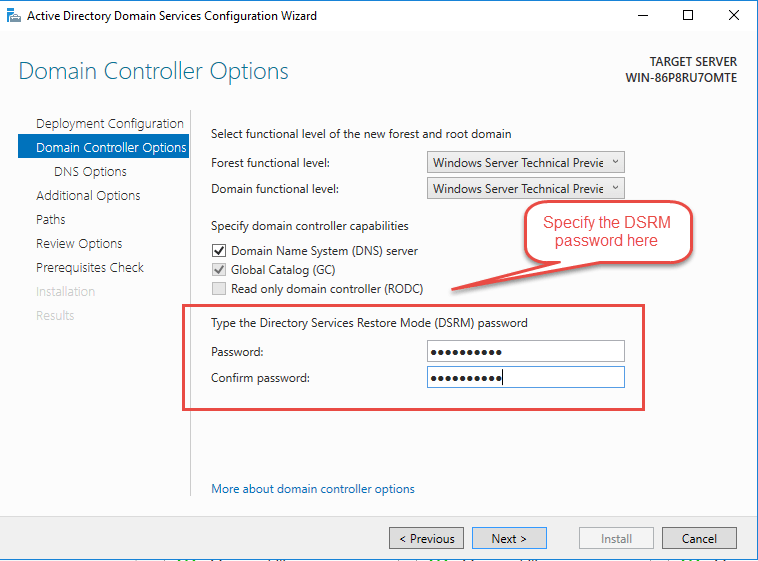
16. So with that being said , I’m choosing the option as “ Windows server 2016 technical preview “ under forest function level and the same for domain functional level too and I’m clicking next. Also make sure you’re specifying the “Directory services restore mode “password also .This password has to be used for safe mode boot option in Windows servers which are acting as domain controllers. Using this password you can repair/recover and restore an Active Directory database.

19.PNG

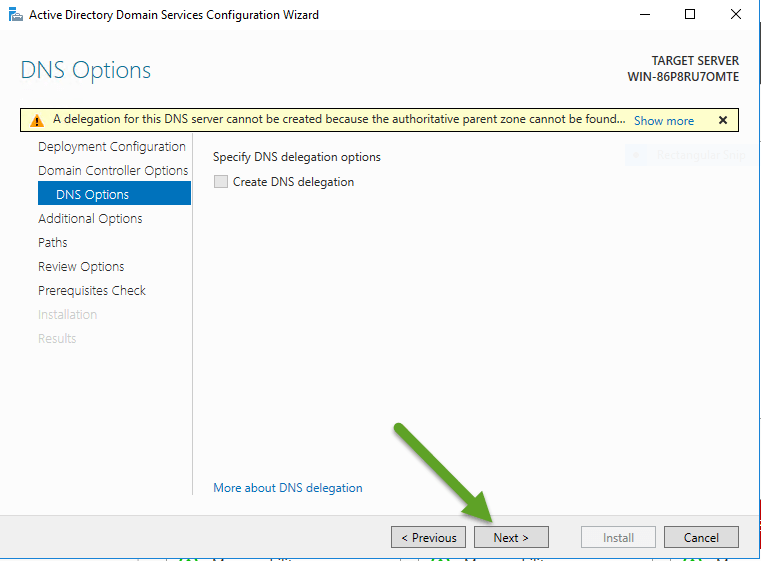
17. On the next screen check the appropriate DNS options and click next.

20.PNG

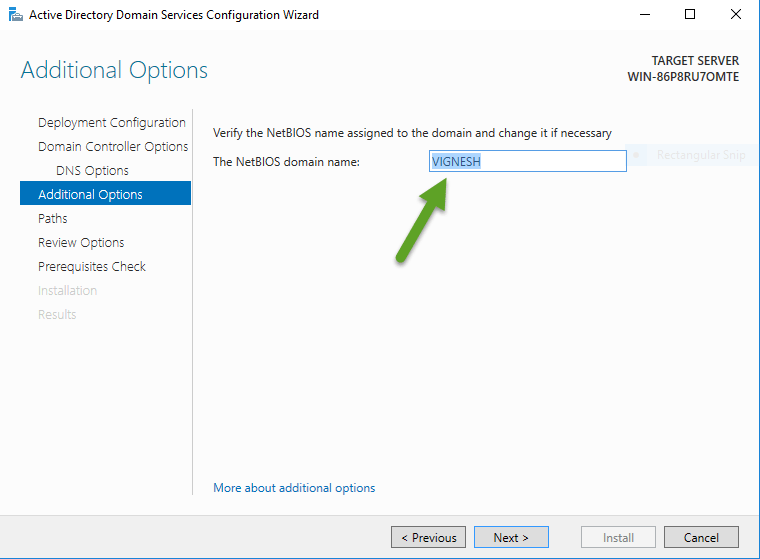
18. Enter the “NetBIOS” name in the next screen and click next.

21.PNG

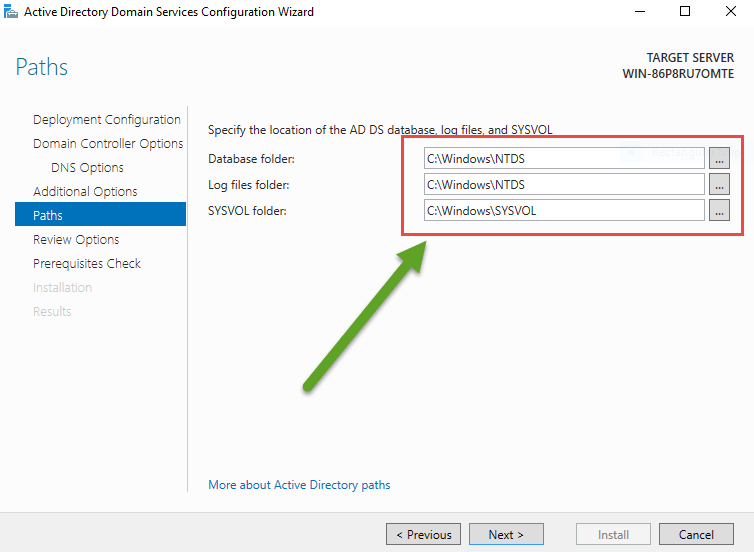
19. On the next screen, you will be asked to specify the AD database path where the “ NTDS.dit” file resides . Also you need to specify the log files path and the path for SYSVOL folder. Ideally the best practice is to keep this as it is .However, you can change the path as per your requirement.

22

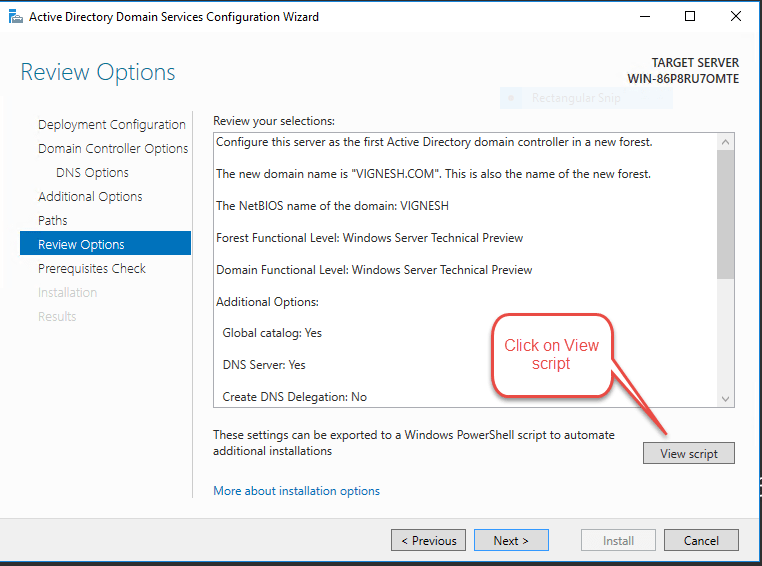
20. Finally, you will get a screen where you can review the settings you made before clicking next.

23.PNG

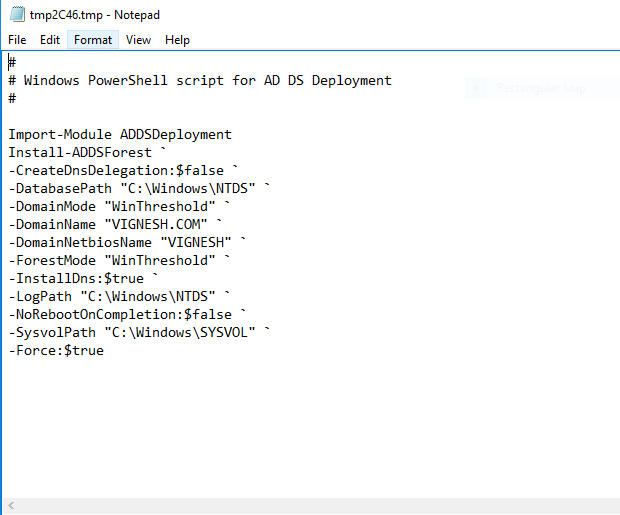
21. You can click on the “View script “option, to view the script for the settings that you have configured. You can use that script for future configurations also if required. This is the screen you will get if you click on the “ View script “ option which displays the PowerShell command for the settings that we have configured .

24

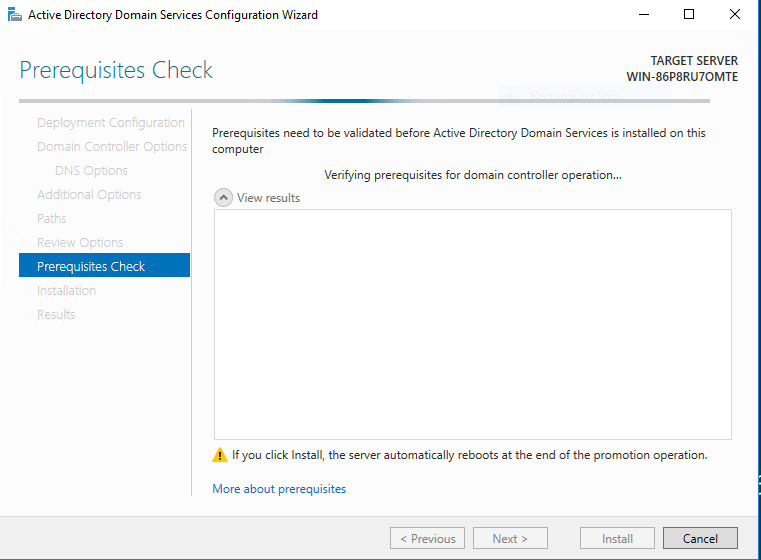
22. Once you’ve verified that and clicked next, you will get a screen as shown below which will run the prerequisites check.

25.PNG

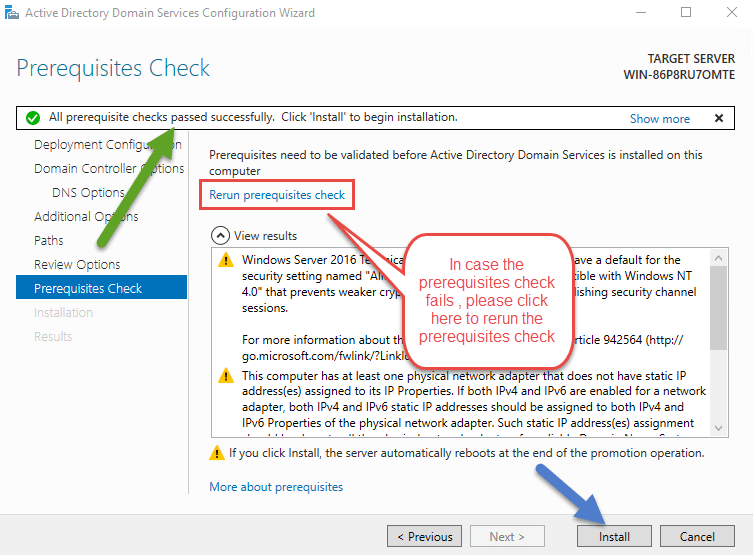
23. Once the prerequisite check is done, you will get a screen as shown below confirming that all the prerequisite checks have passed successfully.

26.PNG

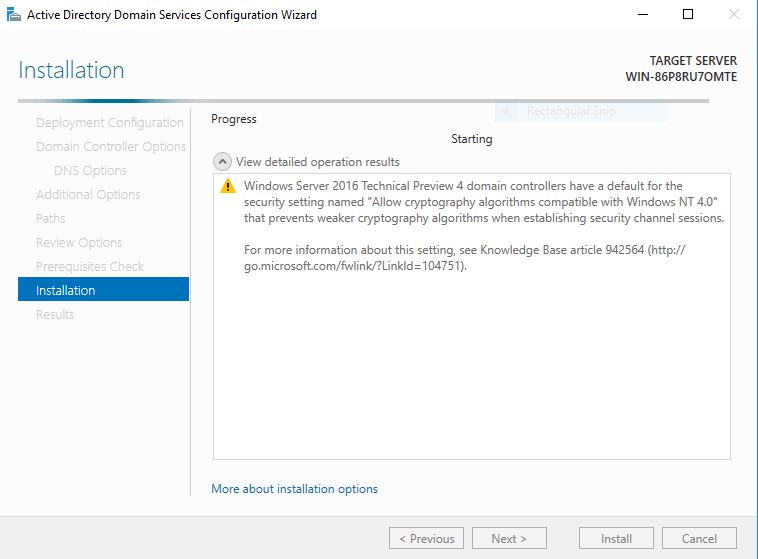
24. Once you have verified that the prerequisites check is completed, go ahead and click on the install button, this will start installing ADDS.

27.PNG

25. Please be patient for few minutes as the installation will take some time .Once the installation is completed you server will be restarted.

28.PNG

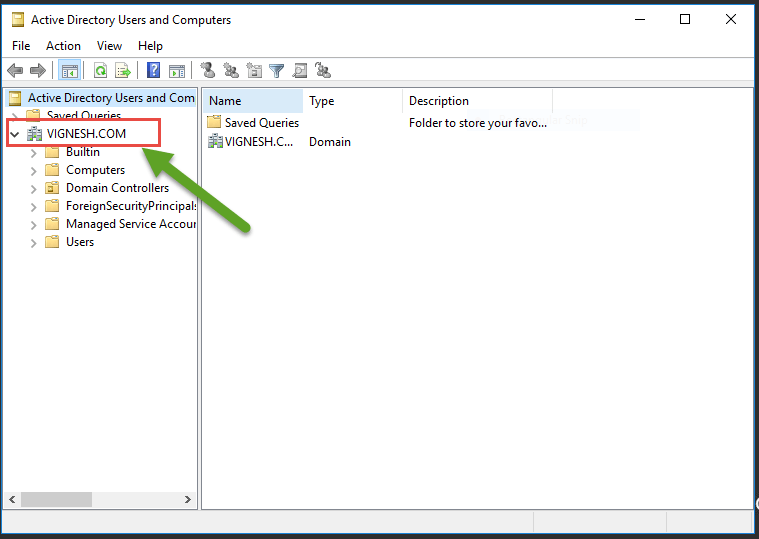
26. Finally, you can verify the ADDS installation in your server by opening the Active directory console.

30.PNG

27. You can see the screen below where I’m logging into the server using the domain credentials.

29.PNG

So this concluded the ADDS installation steps in Windows Server 2016 Technical Preview 4 .Thanks for reading this post .Have a good one .


Steps to deploy a farm solution in a SharePoint Farm:

Steps to deploy a farm solution (wsp file) in a SharePoint Farm:

Please follow the steps below to deploy a “farm solution” in a SharePoint Farm (both 2010 & 2013). A farm solution is something that can have an impact on the entire farm when deployed and being a SharePoint Administrator you can activate this on a specific web application or (on multiple web applications if you use the full-trust model ).

  1. Login to the SharePoint WFE server using the “SharePoint Farm account “.
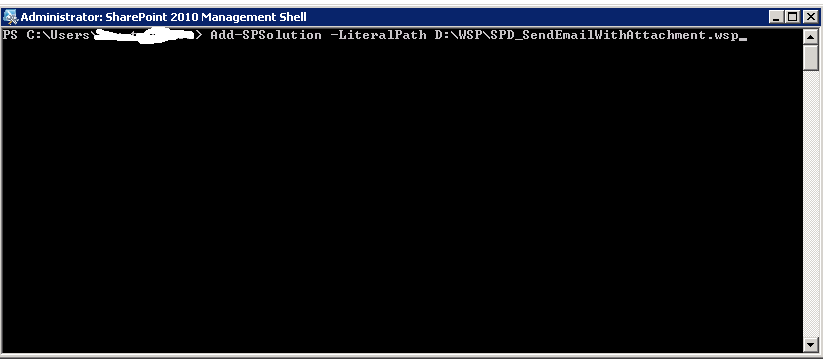
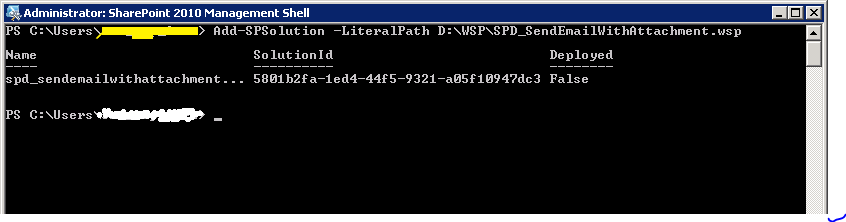
  2. Open the “SharePoint Management Shell “window with elevated permissions and type the below command as show in the screenshot.

“ Add-SPSolution –LiteralPath D:\WSP\SPD_SendEmailWithAttachment.wsp”

1.png

Literal Path –>  Mention the folder path where you have saved the .wsp file.

SPD_SendEmailWithAttachment –> Here in this scenario the name of the wsp file that we are deploying is “SendEmailwithAttachment” and hence it has been named so.

WSP –> WSP stands for Windows SharePoint.

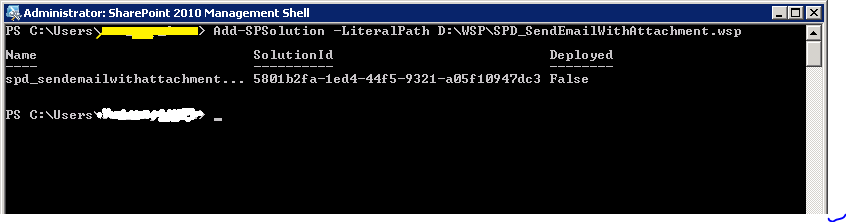
  1. Once you’re done typing the above command, hit “enter “and it will give you the details of the wsp file as shown below.

2.png

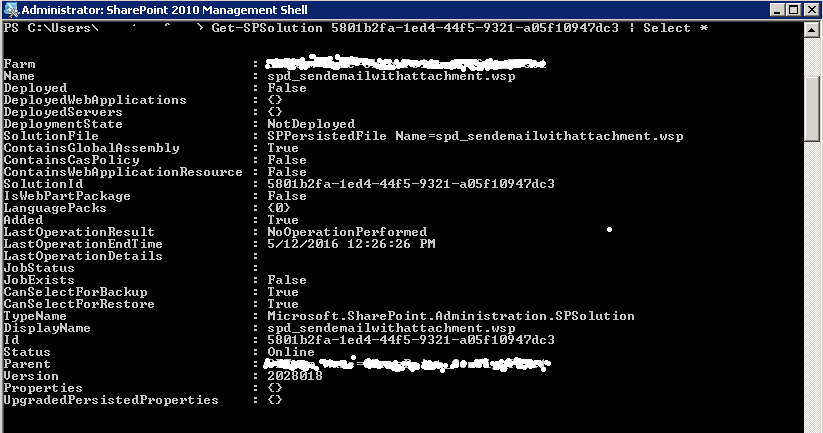
4. Once you’re done with that, run the below mentioned command to get the details of the .wsp file. Please make sure you’re copying the solution ID properly.

3.png

5. Now since you’re done with adding the farm solution, please go ahead and run the below mentioned command to install it. Please check the screenshot below for reference

“Install-SPSolution –Identity “solution ID” –GACDeployment”  (Solution ID would be the ID which you see in the screenshot below)

4.png

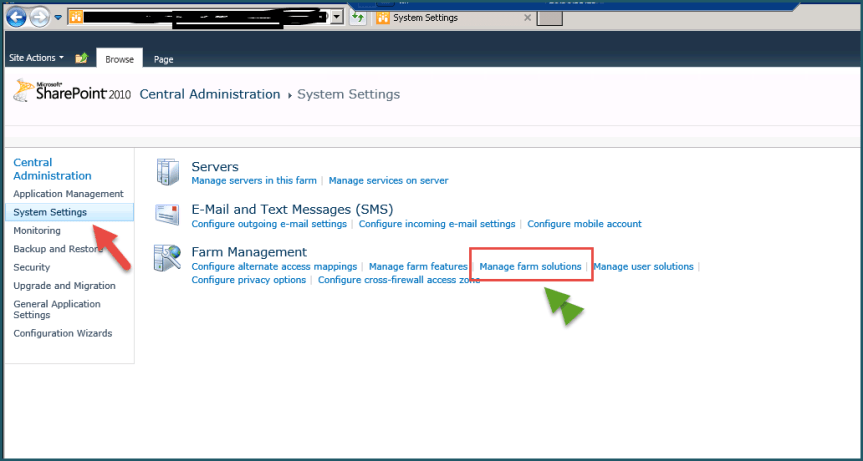
6. Finally, once you’re done installing the farm solution please navigate to “System settings” in Central Administration and click on “Manage farm solutions” as shown below.

5

7. Please check whether you’re able to see the wsp file that you currently deployed in the list of wsp files available there. In our scenario the wsp file name is “spd_sendemailwithattachment.wsp” and you can see that in the list of wsp files that has been deployed on the farm.

6.png

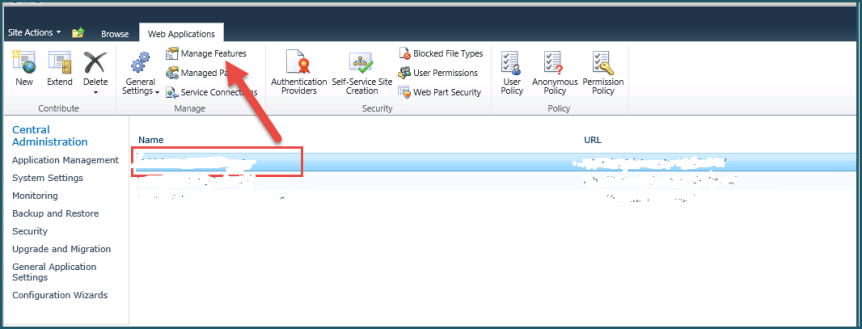
8. Since we have verified that the .wsp file has been deployed successfully, the next step would be to activate the feature on the web application. For this click on “Manage web applications” in Central Administration –>Select the web application on which you need to activate the feature –> click on Manage features on the top ribbon interface.

7.png

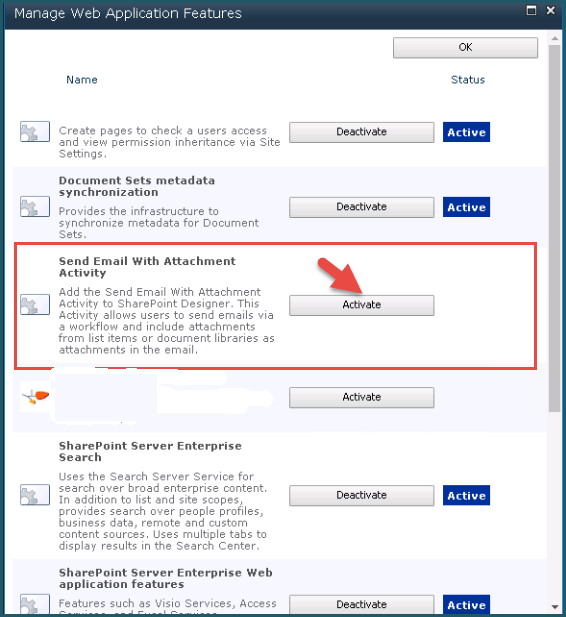
9. Finally check for the feature related to the solution that we deployed and click on activate (check screenshot below).

8


Thanks for reading this post . Happy SharePointing!!!


Setting up Windows Server 2016 Technical Preview 4 in Hyper-V:

Setting up Windows Server 2016 Technical Preview 4 in Hyper-V:

This article will give you a step-by-step explanation on how to set up Windows server 2016 Technical Preview 4 on Windows 10 Hyper-V:

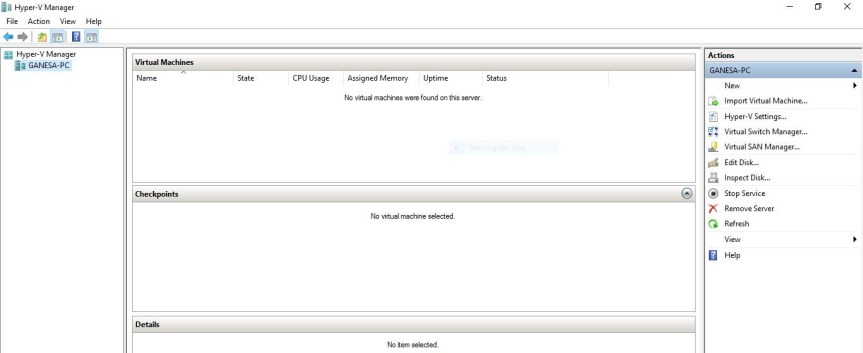
  1. Open the Hyper-V manager console as shown in the screenshot below.

Note: If you’re not able to find Hyper-V on windows search, then that’s probably because you haven’t turned that on under “Turn Windows feature on or off” in Control Panel. So please make sure that is turned on

1

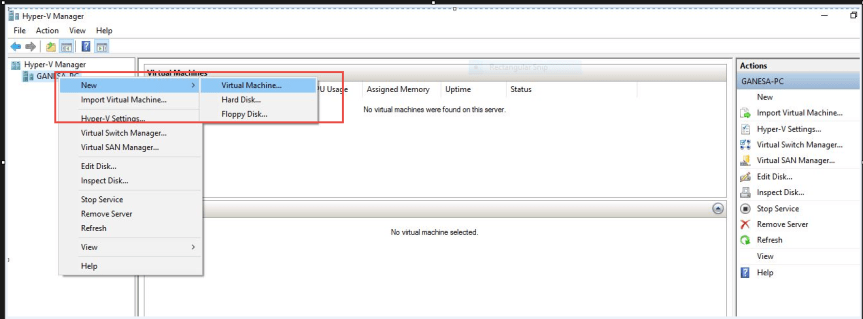
2. Click on “New” and choose “New Virtual machine “option as shown in the screenshot below.

2.png

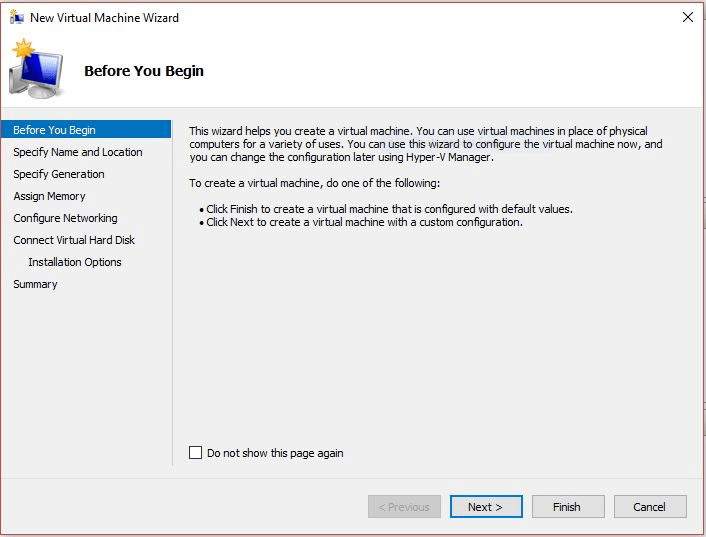
3. Click “ Next”

3.png

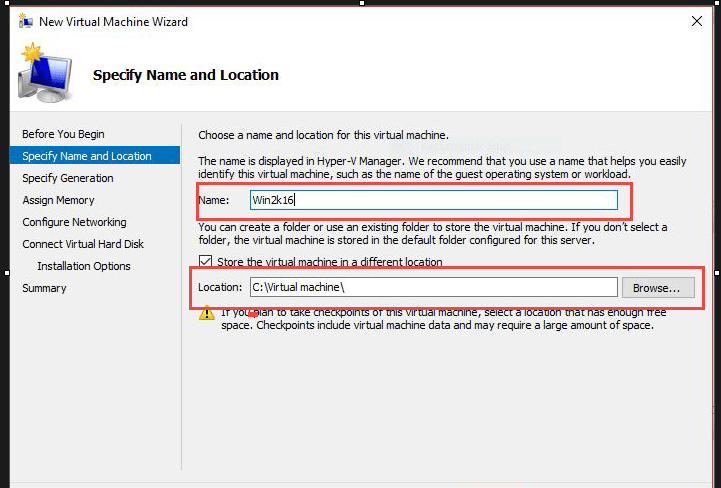
4. In the next screen you need to specify the “Name” of the virtual machine and also the “location” to save it. Check screenshot below.

4.png

5. In the next screen you need to specify which “generation” you’re planning to go with. Now choosing the correct generation depends on certain criteria’s and please check this link for reference. Here, in this scenario I’m planning to go with “Generation 1” as this serves my purpose.

5.png

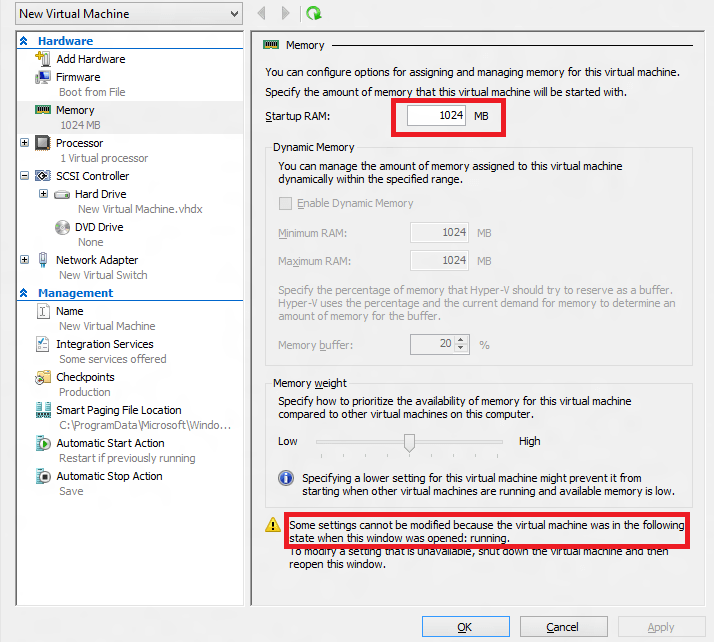
6. Specify the “RAM” configuration in the next screen, I’m planning to assign 4000 MB for this Virtual machine .However, if you check the “Dynamic memory” check box, then the Hyper-V will automatically re size the RAM configuration based on the application it hosts/runs.

6.png

NoteStarting in Windows 10/Windows Server Technical Preview, Hyper-V allows you to resize virtual machine memory without shutting down the virtual machine. To know how to do this, please check the screenshot below.

You can notice the “ Startup RAM”  being enabled for you , which means you’re allowed to change the “Startup RAM “ settings even when the Virtual machine is running .This was not the case in the previous version of Windows server and client Operating systems . This functionality got newly added in Windows 10/Windows server technical preview.

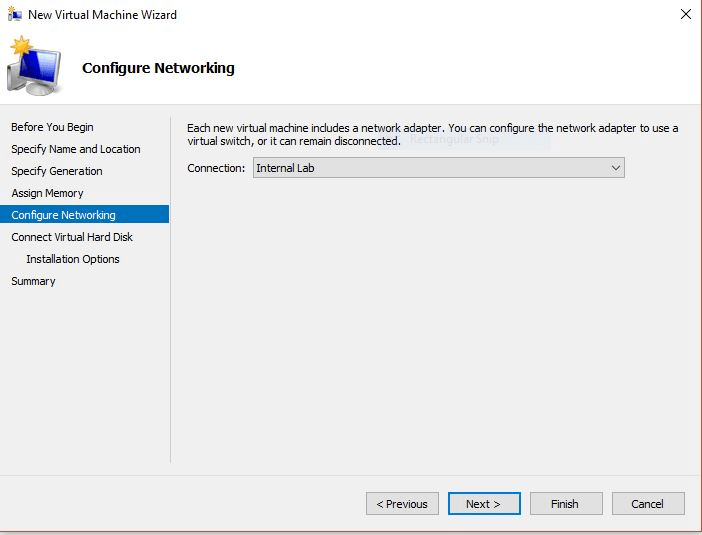
7. In the next screen, you need to specify the “Network” settings for creating the connection. This is something which has to be done prior hand itself before creating the “Virtual machine “ .You don’t need to worry if you didn’t configure this before creating the virtual machine as this can be done even after creating the “Virtual Machine” .

7.png

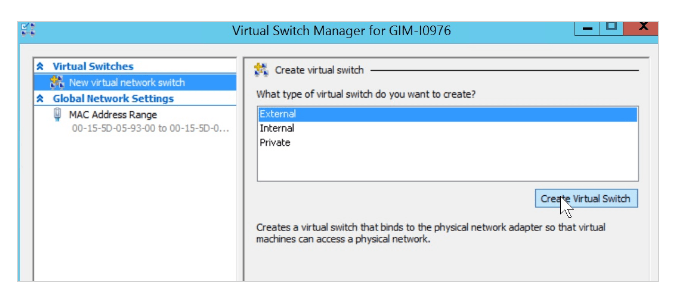
8. Now, if you need to identify which “Virtual switch” to use for your Hyper-V manager, then please check the options below. You need to choose the appropriate one based on your need.

8.png

a. External Switch will link a physical NIC of the Hyper-V host with a virtual one and then give your VMs access outside of the host, meaning your physical network and internet (if your physical network is connected to internet).

b. Internal switch should be used for building an independent virtual network when you need to connect VMs to each other and to a hypervisor as well.

c. Private switch will create a virtual network where all connected VMs will see each other, but not the Hyper-V host. This will completely isolate the VMs in that sandbox.

9.png

9. In the next screen you need to specify the “storage” size. I’m specifying “40GB” as the storage size here.

10.png


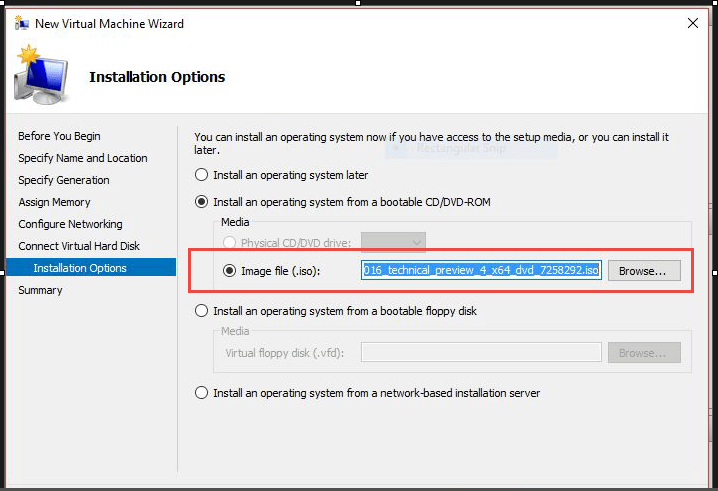
10. Please specify the “installation media” on the next screen. I’m choosing the “Image file” option as shown in the screenshot below as I’ve already saved the image file for Windows Server 2016 Technical Preview (i.e. ISO file) on my hard drive. Browse to the location where you have saved the Image file and add it.

11.png

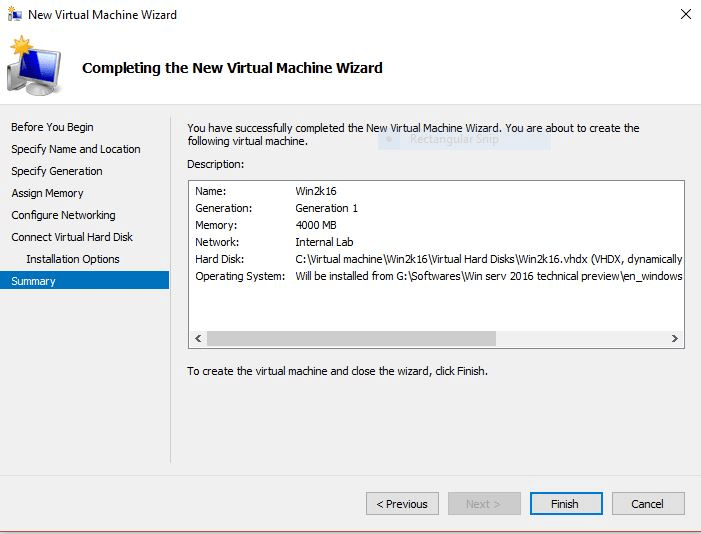
11. The next screen will give you a summary of all the specifications you made.

12.png

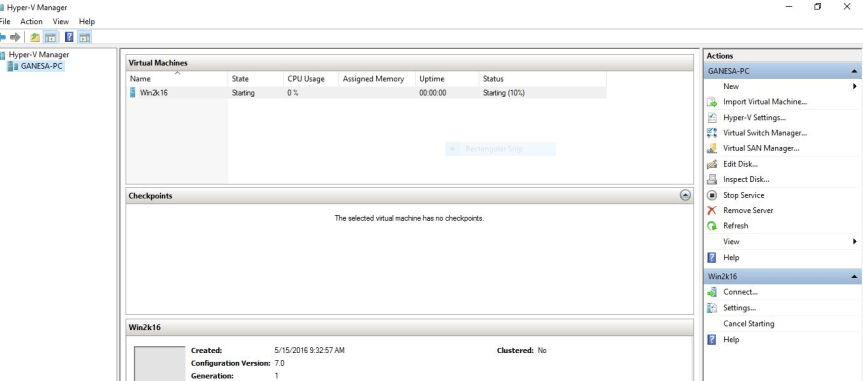
12. Finally once that’s done please click on the “Finish” button and that will start the Virtual machine configuration. You can also see the new Virtual machine you’ve created on the “Virtual machine” console as shown in the screenshot below. You can see “Win2K16” below ….

13.png

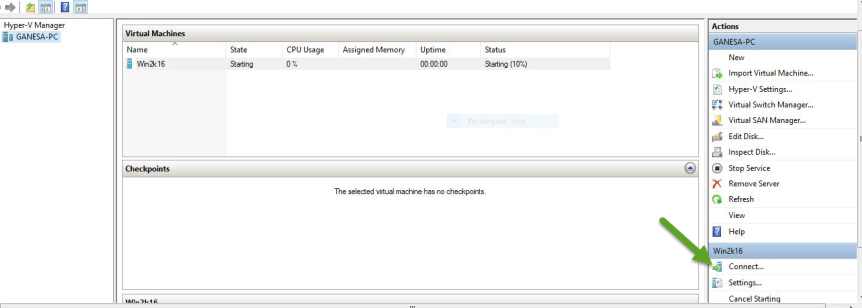
13. Now, it’s time to go ahead and install the “Windows Server 2016 Technical Preview 4 “Operating system as we are done with the Virtual machine configuration. For that, please click on “Connect” as shown below and this will turn on the “Virtual machine “.

14.png

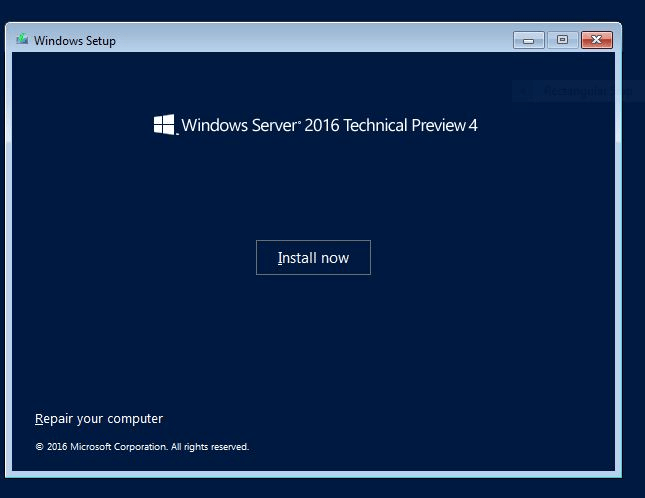
14. Post this step , just follow the traditional Windows OS installation steps which we have been doing for years till now. Hence, to get started, please click on “Install Now “as shown in the screen below.

16


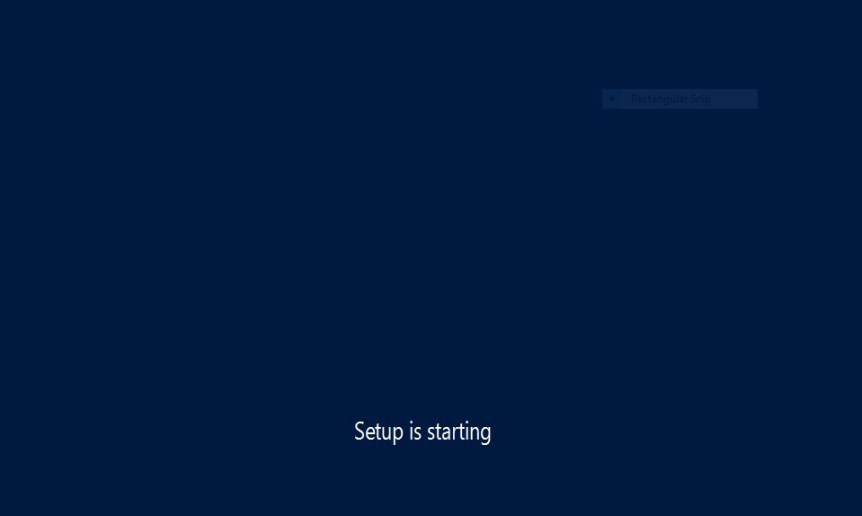
15. The setup is starting now as shown in the screenshot below.

17.png


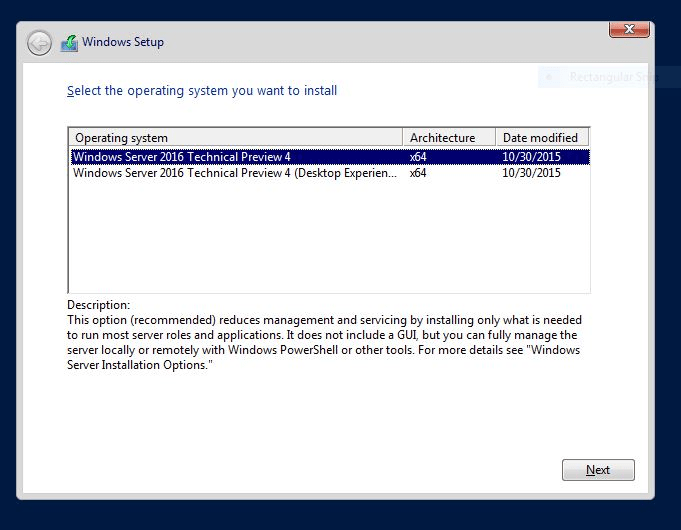
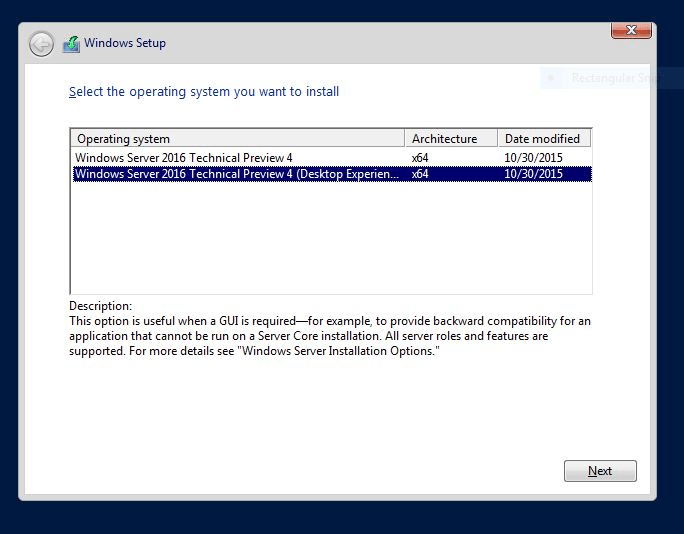
16. Now on the next screen , please choose the appropriate option that suits your need .The first one is server core installation which doesn’t give you a GUI and the next one is the normal ( Desktop experience ) installation which gives you the GUI option .

Server Core option:

18.png

GUI (desktop experience) based installation:

19.png

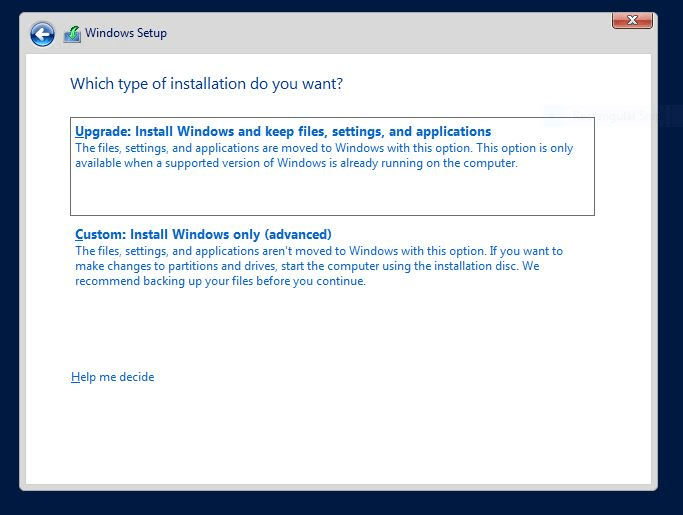
17. Choose Custom installation method.

20.png

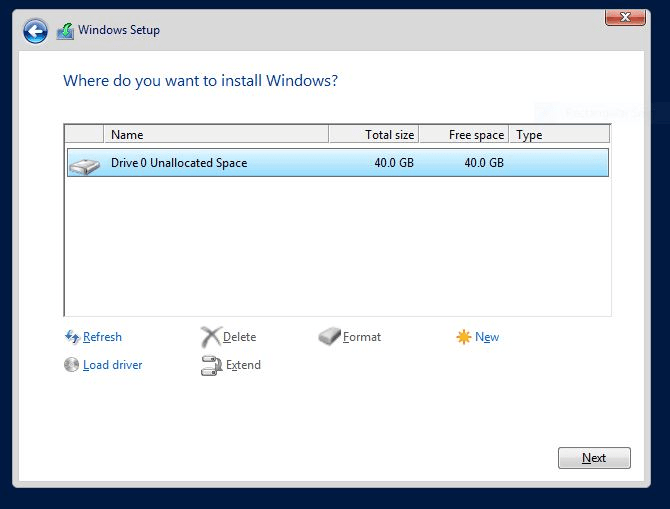
18. Choose the drive to perform the installation on the next screen as shown below.

21.png

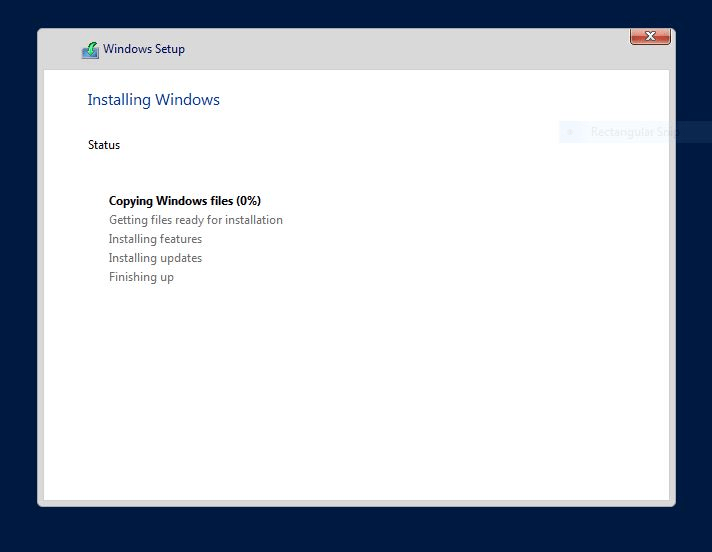
19. Click next and this will start the installation, the entire process would take about 20 minutes max, so please be patient until it’s complete.

22.png

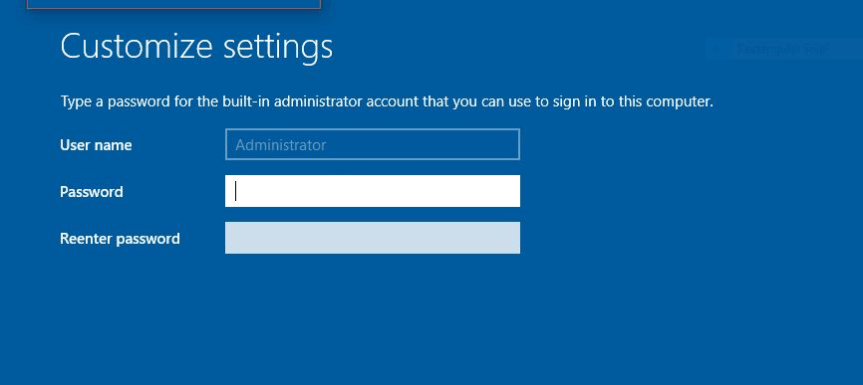
20. Once the installation is done, it will prompt for the administrator password, please go ahead and specify that.

23.png

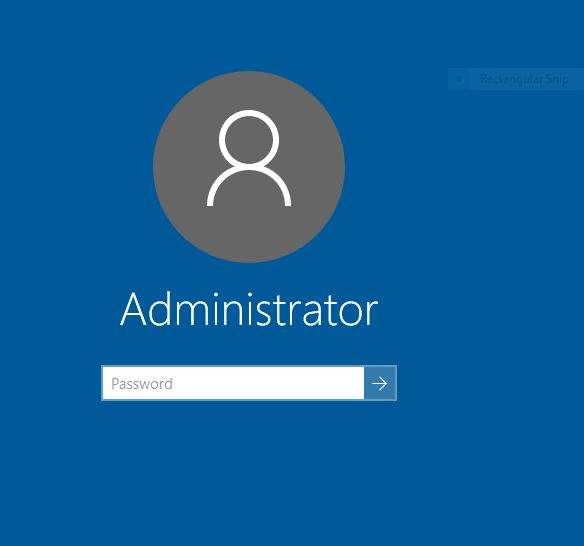
21. On the next screen, press “Ctrl+Alt+Delete” to unlock and key in the Administrator password.

24.png

22. You should be all set by now with the installation and now you can see Windows Server Technical 2016 preview 4 spinning on your new Virtual machine.

25.png

Monitoring Search service in SharePoint:

Alright are you one of those guys who manages the SharePoint infrastructure in your firm all alone? Do you think you’re really doing a good job in monitoring all the mission critical services such as Search, User profile services, Managed metadata, BI & BCS? Well if you’re already doing that then kudos to you but if you’re not then you definitely know how messier things could get if they break and you didn’t notice that .

So with that being said I’m going to discuss about monitoring Search service in this post. You see, the problem with search is, it always needs some extra caring and boosting when compared to other SharePoint services. If you just deploy search service and then test it and say “Alright…I’m done deploying search …It works fine, my users can get what they want and I’m a happy person now”…. then you’re making a very bad mistake .If there is any other application you treat this way then I just can’t think about how bad the aftermath would be.

Well ,I don’t mean to scare you guys ,but being SharePoint practitioners  don’t you guys think Search needs a little more extra caring ? I would say yes it does and the purpose of this post is to let you know about the inbuilt tools that SharePoint search service offers to diagnose/monitor it and how you guys can start doing that if you’re not doing that already.

As you all know, Search is really  mission critical for any successful SharePoint based intranet portal and it’s the job of the SharePoint engineer (you)  to perform the below mentioned steps  to check and ensure that the search service is running fine without any issue.

Note: It probably won’t be a good idea to do all these steps on daily basis unless you really want to spend couple of hours every day just in monitoring search .However, it would still make sense to perform step 2,7 & 14  everyday just to make sure that search is running fine . You can perform all the other steps on a weekly basis.

Alright now let’s get into the real meats and potatoes…..

1.Access the Search service application from the Central administration using the Farm admin account .(If you’re not given Farm admin rights, make sure you’re atleast given Search service application administration rights )

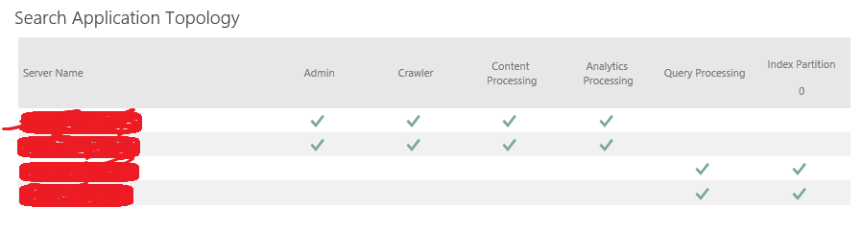
2. Once you’re in the “Search Administration “ page take a look at the Search Application topology section and make sure all the search components shows up green . Take a look at the screenshot below.

1

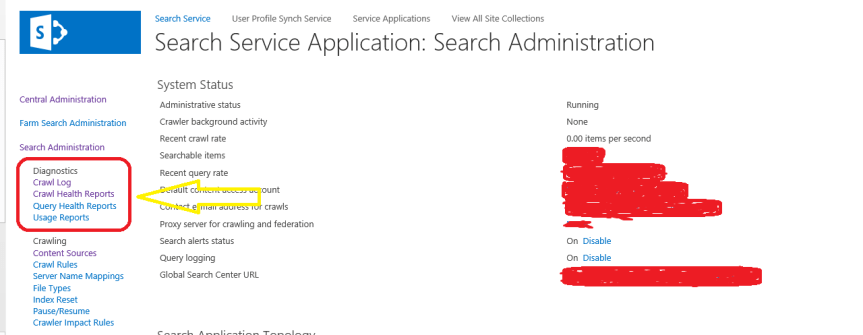
3. Once you confirmed that everything shows up green, now it’s time to take a look at the Crawl For this navigate to the “Diagnostics section in the Search administration page as shown in the screenshot below and take a look at the “Crawl Logs “ .

2

4. The search crawl logs can help you identify the below mentioned three things ….

a) Whether crawled content was successfully added to the index

b) Whether it was excluded because of a crawl rule

c) Whether indexing failed because of an error.

 5. Make sure you take a look at everything and ensure that the results are fine.

6. Also you get different views such as (Content Source, Host Name, Crawl History, Error Breakdown, Databases, URL View) for the Crawl logs in the diagnostics section. Take a look at all these sections and ensure that the results are fine .Check for Errors and see if the count is high, if yes take a look at what’s triggering the errors. I made a different post on working with Search crawl logs before, please click here to access it.

7. Once you’re done with that, take a look at the “Crawl Health reports “and check each and every section there. You get the reports on all the below mentioned areas.

  • Crawl Latency
  • Crawl Queue
  • Crawl Freshness
  • Content Processing Activity
  • CPU and Memory Load
  • Continuous Crawl

3

8. You also get to apply filters so that you can get a customized view.

9. Now let’s take a look at what information each and every criteria has under the Crawl health reports.

A) Crawl Rate

For a specified time interval, shows a graph and a summary of the following:

  • Number of content items crawled per minute. This includes:
  • Total content items
  • Modified items. These are content items that were changed and re-crawled.
  • Not modified items. These are content items that were not changed and were not crawled.
  • Security items. These are content items for which the security attributes were changed.
  • Deleted items. These are content items that were deleted from the content source and which must also be deleted from the index.
  • Average number of other crawl actions that were performed per minute. This includes:
  • Retries (crawl retries)
  • Errors (crawl errors)

You can filter this report by:

  • Start date/time
  • End date/time
  • Content sources (for example, Local SharePoint sites)
  • Machine

B)Crawl Latency:

For a specified time, shows a graph of the number of items that form the crawl load, for each of the following:

  • In Crawler Queue
  • Waiting to submit to content processing
  • Submitted to content processing
  • Waiting to Commit (SQL)

You can filter this report by machine only.

For a specified time interval, also shows a graph and a summary of the crawl latency; the amount of time in milliseconds that each content item is in each of the following subsystems in the feeding pipeline:

  • Crawler
  • Protocol handler (PH)
  • Repository
  • SQL Time

You can filter this report by:

  • Start date/time
  • End date/time
  • Content source (for example, Local SharePoint sites)
  • Machine

10. Pay close attention to the “Latency “and “CPU and Memory Load” section and make sure the graph looks fine without any abnormal spikes. You also have an option to apply filters, if necessary apply filters and take a look at all the search components.

11. Finally navigate to the crawling section as shown in the figure below and take a look at the content sources.

C) Crawl Queue:

For a specified time interval, shows the number of items in the following two crawl queues:

  • Links to process. This is the number of uncrawled URLs that are queued to be crawled.
  • Transactions queued. This is the number of crawled URLs that are queued to be processed in the crawl pipeline.

You can filter this report by start date/time and end date/time.

D) Crawl Freshness:

For a specified time interval, shows the freshness of the content that was being indexed by the search system. The last modified time stamp of each document is compared with the time specified in the graph. You can view the freshness of the content as follows:

  • Less than 1 month ago
  • Less than 1 week ago
  • Less than 1 day ago
  • Less than 4 hours ago

E) Content Processing Activity:

For a specified time interval, shows the amount of time that was spent in content processing for:

  • Content sources
  • Machines
  • Content processing components
  • Content processing activity

The graph shows the amount of time that was spent in various content processing activities, such as:

  • Linguistics processing
  • Document parsing
  • Document summary generation
  • Indexing

You can filter this report by:

  • Start date/time
  • End date/time
  • Content source
  • Machine
  • Content processing component name
  • Processing activity

F) CPU and Memory Load:

For a specified time interval, shows the percentage of CPU used, the memory use in megabytes and the system overview for these processes:

  • MSSDmn
  • MSSearch
  • NodeRunner
  • Timer

You can filter this report by:

  • Machine
  • Start date/time
  • End date/time

G) Continuous Crawl:

For a specified time interval, shows the time (in milliseconds) that the processes took with an overlay of discovery time (in minutes) for:

  • Time In Links Table
  • Time In Queue Table
  • Crawler Time
  • PH (Protocol Handler) Time
  • Repository Time
  • Content Pipeline Time
  • SQL Time

You can filter this report by:

  • Content sources
  • Start date/time
  • End date/time
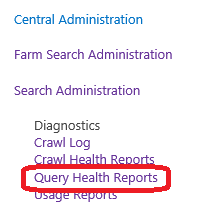
  1. Once you’re done checking the “Crawl Health Reports” now it’s time to take a look at the “Query Health reports “.For this click on the “Query Health Reports “link under Diagnostics section as shown in the image below.

4

11. Here you will get reports based on the below mentioned criteria’s and you can filter them as well as per your need.

  • Trend
  • Overall
  •  Main Flow
  • Federation
  • SharePoint Search Provider
  • People Search Provider
  • Index Engine

A)Trend (Query Latency Trend):
For a specified time interval, shows the query latency (in milliseconds) by percentile. For example, five percent of all queries had lower latency than the latency indicated by the fifth percentile line in the graph.

The graph includes an overlay of query rate during the specified time interval, where query rate is the number of queries per minute for which the query object model (OM) returned results.

The graph also includes an overlay of the crawl rate and the partial update rate for analytics.

You can filter this report by:

  • Start date/time
  • End date/time
  • Client type
  • Result page (search results page), which only shows if verbose logging is enabled.

By default, the graph displays data for all result pages in the Search service application.

B)Overall (Overall Query Latency):

For a specified time interval, shows the query rate (number of queries per minute) with an overlay of query latency in milliseconds.

Shows the query latency in each of the following areas:

  • Object model. This is the time it takes to communicate between the web server and the back-end.
  • This is the time it takes to transform the query, perform index look up, process results (such as removing duplicates), and return results to the object model.

You can filter this report by:

  • Start date/time
  • End date/time
  • Client Type
  • Result page (search results page), which only shows if verbose logging is enabled.

By default, the graph shows data for all result pages in the Search service application.

C)Main Flow (Default SharePoint Flow Query Latency):

For a specified time interval, shows the query latency (in milliseconds) in the main flow for query and result processing. This indicates how fast the system processes a query and returns results to the web server. The graph shows the query latency for:

  • Query rule condition matching
  • Query transformation
  • Query routing
  • Result mixing
  • Layout selection
  • Query logging
  • Other

The graph includes an overlay of query rate during the specified time interval.

You can filter this report by:

  • Start date/time
  • End date/time
  • Client Type

D)Federation (Federation Query Latency):

For a specified time interval, shows the query latency in milliseconds for all result source types.

By default, the graph shows data for all result pages in the Search service application.

You can filter this report by:

  • Start date/time
  • End date/time
  • Client type
  • Result page (search results page), which only shows if verbose logging is enabled.
  • Source type (result source type):
  • Best Bet Provider
  • Exchange Search Provider
  • Local People Provider
  • Local SharePoint Provider
  • OpenSearch Provider
  • Personal Favorites Provider
  • Remote People Provider

E)SharePoint Search Provider (Local SharePoint Search Flow Query Latency):

For a specified time interval, shows the query latency (in milliseconds) for all queries that are processed by the local SharePoint search provider. The graph shows the query latency for:

  • Keyword parsing
  • Linguistics
  • Recommendations Security Trimming
  • Security token construction
  • Index lookup
  • Result type processing
  • Custom security trimming
  • Summary generation
  • Other

The graph includes an overlay of query rate during the specified time interval.

You can filter this report by:

  • Start date/time
  • End date/time
  • Client type

 F)People Search Provider (People Search Flow Query Latency):

For a specified time interval, shows the query latency (in milliseconds) for all queries that are processed by the local people search provider. The graph shows the query latency in each of the following areas:

  • Keyword parsing
  • Linguistics
  • People pre-processing
  • Security token construction
  • Index lookup
  • Result type processing
  • Custom security trimming
  • Summary generation
  • Other

The graph includes an overlay of query rate during the specified time interval.

You can filter this report by:

  • Start date/time
  • End date/time
  • Client type

G)Index Engine (Index Engine Query Latency:

For a specified time interval, shows the query latency in milliseconds for each index server that you filter on. By default, the graph shows data for all result pages in the Search service application. You can filter this report by:

  • Start date/time
  • End date/time
  • Index server (a computer that hosts at least one index partition)
  • Result page (search results page), which only shows if verbose logging is enabled.

The graph includes an overlay of the index lookup time for the specified time interval in the past. Index lookup time is the average amount of time during a given minute that it took the index engine to return results. The index lookup time applies only to queries for which the index engine returned results.

13. Once you’re done with the “Query Health Reports “, now it’s time to take a look at the “Usage reports “in the diagnostics section. Similarly as the other reports, you can also filter these reports based on different criteria’s.

Note: The “Query Health” Reports can also be useful if you want to do some analysis on how your users are using search? What do they search for? What is the mostly searched content? etc. …This report can also be useful for you to enhance search as per your user’s search queries. Also if your users yell at you saying, “Search is really awful, I’m not able to find what exactly I need “…Then in those scenarios you probably need to do some tweaking with the Query Health reports.  You can also consider implementing “Query Rules” if necessary based on the reports.

A) Number of Queries:

This report shows the number of search queries performed. Use this report to identify search query volume trends and to determine times of high and low search activity.

B) Top Queries by Day:

This report shows the most popular search queries. Use this report to understand what types of information visitors are seeking.

C) Top Queries by Month:

This report shows the most popular search queries. Use this report to understand what types of information visitors are seeking.

D) Abandoned Queries by Day:

This report shows popular search queries that received low click-through. Use this report to identify search queries that might create user dissatisfaction and to improve the discoverability of content. Then, consider using query rules to improve the query’s results.

E) Abandoned Queries by Month:

This report shows popular search queries that received low click-through. Use this report to identify search queries that might create user dissatisfaction and to improve the discoverability of content. Then, consider using query rules to improve the query’s results.

F) No Result Queries by Day:

This report shows popular search queries that returned no results. Use this report to identify search queries that might create user dissatisfaction and to improve the discoverability of content. Then, consider using query rules to improve the query’s results.

G) No Result Queries by Month:

This report shows popular search queries that returned no results. Use this report to identify search queries that might create user dissatisfaction and to improve the discoverability of content. Then, consider using query rules to improve the query’s results.

H)Query Rule Usage by Day:

This report shows how often query rules trigger, how many dictionary terms they use, and how often users click their promoted results. Use this report to see how useful your query rules and promoted results are to users.

I)Query Rule Usage by Month:

This report shows how often query rules trigger, how many dictionary terms they use, and how often users click their promoted results. Use this report to see how useful your query rules and promoted results are to users.

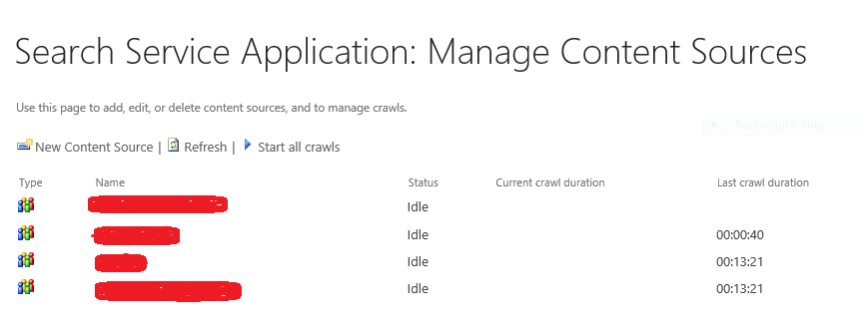
14. Finally as a best practice it would also make sense to take a look at the search content sources and ensure that the crawls are running fine (This step goes without saying and I guess you would be doing this in the initial phase of troubleshooting/monitoring SharePoint search).

6

15. Ensure that all the crawls are running fine and make sure the time difference between the previous and the next crawl is running on equal time intervals .If you see some abnormal time difference between the previous and the next consecutive crawl then obviously something is wrong and it would be really worthwhile to take a look at the crawl logs.

Thanks for reading this post .Happy SharePointing!!!

SharePoint Online limits across different Office 365 plans:

SharePointOnline2L-1

Found this good article on Tech Target Network about SharePoint Online limitations and wanted to share it with you guys ….

Depending on the Office 365 plan your business uses, there are several SharePoint Online limits to keep in mind when planning a SharePoint migration.

As with most software as a service deployments, Microsoft imposes limits on the SharePoint Online service across its various Office 365 plans. Organizations with the appropriate service plan can typically work within those limitations, but it’s important for IT planners to recognize restrictions in advance and ensure that any migration from a local SharePoint deployment to SharePoint Online will remain within the established limits. Otherwise, the online migration may experience problems or incur unexpected premium costs for additional resources.

SharePoint Online limits typically involve storage and maximums in the number of items, users, subsites and file sizes. Consider SharePoint Online in Office 365 Business Premium, which offers base storage of 10 GB per tenant plus up to 500 MB per subscribed user; additional storage can be purchased for a fee. For example, a business with 5,000 users would see a storage limit of about 2.5 TB. This might sound like a lot, but storage-intensive file collections across many users can easily consume a significant portion of that capacity. Other factors like Recycle Bin storage can also count against storage limits.

The Office 365 Business Premium plan imposes other limits such as up to 1 TB per site collection or group document library, synchronizing up to 5,000 items — such as folders and files — in site libraries, synchronizing up to 20,000 items in the OneDrive for Business library, and handling up to 500,000 site collections where each site collection can support up to 2,000 subsites. Users can upload files as large as 2 GB per file, but can only attach files up to 250 MB.

There are also SharePoint Online limits on site elements such as lists and libraries, pages and security. For example, a single wiki or webpage can only contain up to 25 Web parts, and a single user can belong to up to 5,000 security groups. Such limits may require changes to existing local SharePoint resources before migration.

The limits for other plans such as SharePoint Online in Office 365 Enterprise, Education and Government may differ from the Business Essentials or Business Premium plans. It’s always important to check the needs of your SharePoint deployment against the preferred plan to ensure that you’re getting the most appropriate and cost-effective service. It’s also worth checking the site elements to see which, if any, sites or wikis may require changes.

SharePoint 2016 IT Pro certifications:

Sharepoint2016-670x380-670x380


Microsoft has announced the IT Pro certifications for SharePoint 2016 and they are expected to be  out by July this year . Take a look at this link below to know more about these certifications .


https://www.microsoft.com/en-sg/learning/course.aspx?cid=20339-1

https://www.microsoft.com/en-sg/learning/course.aspx?cid=20339-2

Useful SQL Queries for SharePoint Practitioners:

The SQL queries listed below can be very useful for SharePoint Farm administrators to manage/administer the SharePoint content databases .

Note: The queries mentioned below are not specific only to SharePoint databases and can be used with any SQL database.

1.To get the total number of space utilized by all the SharePoint databases in SQL server:

SELECT CONVERT(DECIMAL(10,2),(SUM(size * 8.00) / 1024.00 / 1024.00)) As UsedSpace
FROM master.sys.master_files

2.To get the name of all the SharePoint databases in a SQL instance :

Select * from Sys.Databases

3.To get the total number of space utilized by all the SharePoint databases in SQL server:

SELECT CONVERT(DECIMAL(10,2),(SUM(size * 8.00) / 1024.00 / 1024.00)) As UsedSpace

FROM master.sys.master_files

4.To find the space used by a SharePoint DB and its free size :

*Replace MY_DB with the concerned database name

use “MY_DB”
exec sp_spaceused

5.To find the size consumed by SharePoint Databases individually in SQL Server:

SELECT DB_NAME(database_id) AS DatabaseName,


Name AS Logical_Name,


Physical_Name, (size*8)/1024 SizeMB


FROM sys.master_files

6.To get the total number of SharePoint databases in the SQL server:

select  * from sys.databases

or

select  COUNT(*) from sys.databases

7.To find the path for SQL Server error logs:

sp_readerrorlog

8.To get the total number of site collections in a Web application :

select  count(*) as ‘Total Site Collection’ from sites

Note: Point to the content database hosting that site collection and run this query

9.To get the total number of sites in a web application :

select count(*) from Webs

Note: Point to the content database hosting that site collection and run this query

10.To get the Site Title and Site ID :

select Title as ‘Site title’,FullUrl, SiteId as ‘Site Collection Id’ from Webs order by SiteId

11.To get the number of sites under each site collection in a web application :

select SiteId, count(*) as ‘Total Sub Sites’ from Webs inner join Sites on Sites.Id = Webs.SiteId group by SiteId

Note: Point to the content database hosting that site collection and run this query


Useful tools for SharePoint Practitioners:

This post brings you a list of useful tools which every SharePoint Practitioner should make use of to make his day to day life easier. I personally don’t know any of the developers who developed these tools so I’m not trying to do some marketing stuff for these tools. I just wanted to share the list with you guys so that you could get benefited out of it.

Note: There are hundreds of paid/free third party tools out there to administer/manage SharePoint and I have not really tried a lot of them .The list which I’ve put together below is something which I’ve been using for quite some time now and just wanted to let you guys know that these tools have been vetted carefully during usage and they are not potentially harmful by any means, plus they are free of cost too and most of them are from code plex.


  1. ULS Viewer

A windows application for viewing SharePoint ULS log files more easily. Supports filtering and easy viewing of data.

Download Link: _ https://ulsviewer.codeplex.com/


  1. SharePoint Manager

The SharePoint Manager 2013 is a SharePoint object model explorer. It enables you to browse every site on the local farm and view every property. Please be mindful that you should have this tool running on a machine which has SharePoint installed on it.

Download Link: _ https://spm.codeplex.com/


  1. Fiddler

The Fiddler tool helps you debug web applications by capturing network traffic between the Internet and test computers. The tool enables you to inspect incoming and outgoing data to monitor and modify requests and responses before the browser receives them. Fiddler also includes a powerful event-based scripting subsystem, which you can extend by using any .NET Framework language.

Download Link: _ http://www.telerik.com/fiddler

  1. Network Monitor

Network Monitor tool can be used for capturing network traffic and protocol analysis.

Download Link: _ https://www.microsoft.com/en-in/download/details.aspx?id=4865


  1. WinDirStat

WinDirStat is a disk usage statistics viewer and cleanup tool for various versions of Microsoft Windows.

Download Link: _ https://windirstat.info/index.html


  1. SharePoint Log Viewer

SharePoint Log Viewer is a Windows application for reading and filtering Microsoft SharePoint ULS Logs.

Key Features:

  • View multiple SharePoint log files at once
  • Search by any field
  • Filter the log by any field
  • File drag & drop support
  • Live monitoring for entire farm
  • Export filtered log entries
  • Bookmark log entries
  • Get popup notification of SharePoint log events from system tray
  • Receive email notifications on errors
  • Redirect log entries to event log
  • Supports SharePoint 2007, 2010 and 2013


Download Link: _ https://sharepointlogviewer.codeplex.com/


  1. SharePoint Feature Administration and Clean Up Tool :

Feature Administration is a tool for SharePoint administrators and developers to manage SP features. It finds and cleans faulty Feature Definitions and orphaned reminders.

The Feature Admin Tool finds faulty Feature Definitions and cleanly uninstalls them.
It finds feature remainders in sites, Site Collections, WebApps and in the Farm, caused e.g. by forcefully uninstalled Features from a farm without deactivating them before. These faulty features, never visible, cause errors.

Download Link: _ https://featureadmin.codeplex.com/


  1. SharePoint Command Builder :

As the name implies, you can use this tool to build SharePoint PowerShell commands that can simplify your daily work.

Link: _ https://www.microsoft.com/resources/TechNet/en-us/Office/media/WindowsPowerShell/WindowsPowerShellCommandBuilder.HTML

  1. SharePoint Manager 2013 Online :

If you’re using SharePoint Online, then this tool could be your best friend. SharePoint Manager 2013 Online, provides the user a quick and easy overview of the structure and data hidden behind the scenes. Unlike the server version on codeplex, this app only uses html and JavaScript leveraging the SharePoint REST API. The well-known navigation tree on the left side and a property panel on the right side deliver an extremely user-friendly interface, which allows the user to burrow into SharePoint Online structure and hidden gems.

Download Link: _ https://store.office.com/sharepoint-manager-2013-online-WA104025157.aspx?assetid=WA104025157


  1. SharePoint 2013 Search Query Tool:

After running the query, you can view all types of result sets returned; Primary Results, Refinement Results, Query Rules Results, Query Suggestions, in addition to the actual raw response received from the Search service.

This can be used both with SharePoint 2013 on-premises and SharePoint Online. I also explained in detail the usage of this tool in a previous blog post. Click here to read that.

Download Link: _ http://sp2013searchtool.codeplex.com/


  1. SharePoint Host name site collection creator :

The SharePoint Host named Site Collection (HNSC) Creator SharePoint Admins to create HNSC via a GUI instead of PowerShell. This can be used by two ways. One of them is a Windows Forms application that needs no installation, and the second one is a SharePoint 2013 farm solution that plugs in the Central Admin for a native SharePoint experience

Download Link: _ https://hnsc.codeplex.com/


  1. SharePoint Designer :

Microsoft SharePoint Designer (SPD), formerly known as Microsoft Office SharePoint Designer, is a discontinued HTML editor freeware specialized in creating or modifying Microsoft SharePoint sites, workflows and web pages. It is a part of Microsoft SharePoint family of products.

Please note that Microsoft has announced that SharePoint 2016 will not have SP Designer 2016 .That has been discontinued in the 2016 version.

Download link: _ https://www.microsoft.com/en-in/download/details.aspx?id=35491

13. Advanced REST Client plugin for Google Chrome:

SharePoint Developers would probably know the power of this tool . There’s an awesome plugin for Chrome called Advanced REST Client which allows you to investigate the REST calls and configure your queries pretty simply through the UI. You get to see the results and the request times directly in the browser and you can play with the parameters etc easily

Download link :_https://github.com/jarrodek/ChromeRestClient

14.  SharePoint Client Browser for SharePoint Online and SharePoint on premises:

Remote SharePoint development is getting more important. Especially with SharePoint Apps. To speed up development, find hidden lists/items/documents, discover the structure or specific artifact properties use the SharePoint Client Browser which supports SharePoint 2010, SharePoint 2013 and SharePoint Online (Office 365)

Uses of this tool?

  • Get insight in your site collection structure
  • Find hidden lists, items or documents
  • Discover artifact properties
  • Easily start PowerShell, via context menu, and run (scripted) queries against your remote site collection
  • Support for both SharePoint 2010 and SharePoint 2013
  • Connect to on-premise or SharePoint Online (Office 365) site collections
  • No installer
  • Remote access from your desktop to site collection via Client Side Object Model (CSOM)
  • Can run remote, no need to run on the SharePoint server itself

Download link : _ https://spcb.codeplex.com